Tata Consultancy Services (TCS) has launched a broad internal and external reset as it positions itself for an artificial intelligence–first future, at a time when the global IT services industry is undergoing its most consequential technology shift in decades. The company’s renewed push signals a clear inflection point in how AI is being adopted—moving decisively beyond pilots and proofs of concept toward scaled deployments that are directly tied to measurable business outcomes.
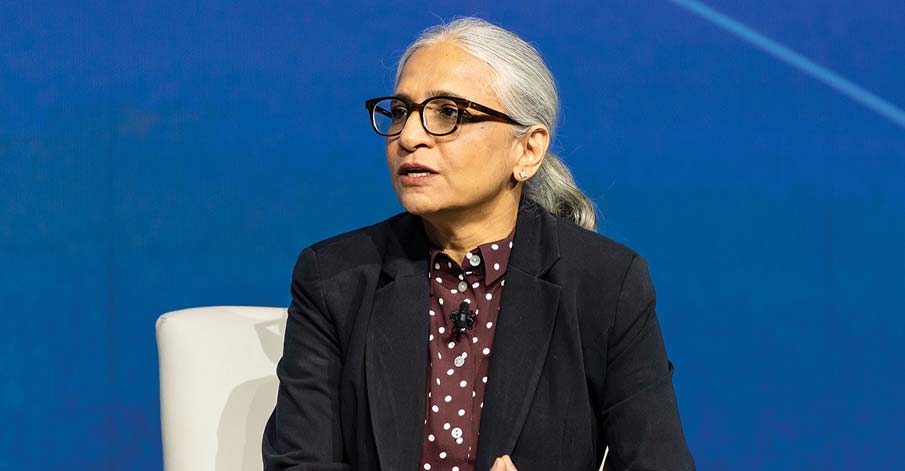
“The current wave represents a deeper structural change than any previous technology cycle, and every conversation today is an AI conversation,” said Aarthi Subramanian, executive director, president and chief operating officer, in an interview.
Leadership Alignment Behind an AI-First Vision
The transformation is being driven by a tightly aligned leadership team, with chief executive officer K Krithivasan articulating an ambition to make TCS the world’s largest AI-led technology services company. In April 2025, Tata Sons reappointed Subramanian as COO as India’s largest software exporter began executing a decisive pivot toward AI.
Before returning to the COO role, Subramanian served as chief digital officer at Tata Sons and earlier held senior roles at TCS, including global head of delivery excellence, governance and compliance.
Together with Krithivasan and chief strategy officer Mangesh Sathe, she is shaping a new operating blueprint for the firm. As part of this push, TCS has appointed Amit Kapoor as chief AI and services transformation officer, reporting to Subramanian, to sharpen execution at scale.
“We are deliberately creating significant leadership bandwidth because this is an era of unprecedented change. That depth at the senior management level is critical to driving transformation at scale, with Krithi leading the charge,” she said, describing her long working relationship with Krithivasan as a partnership built on trust and close collaboration.
Resetting the Services Engine
The strategic overhaul comes against a backdrop of moderated growth. Over the past two fiscal years, TCS has seen relatively modest expansion amid geopolitical uncertainty and AI-driven disruption, even as it crossed the $30 billion revenue milestone in FY25.
In the past six months alone, the company has taken several notable steps to realign its portfolio and cost structure. These include a 2% workforce reduction, impacting around 12,000 employees, entry into the data centre segment, and the completion of its first acquisition in nearly a decade. Subramanian said Krithivasan is reshaping both customer and employee value propositions while defining how TCS must operate in an AI-native environment.
Rethinking Work, Roles, and Talent
Artificial intelligence is also forcing a fundamental rethink of the traditional IT services delivery model. TCS has introduced a five-level autonomy framework across its offerings, designed to help clients progress from automation toward autonomy—where an increasing share of tasks traditionally performed by humans are executed by AI systems.
While certain roles may become redundant in this transition, Subramanian said overall demand will continue to shift toward newer, more complex use cases. As a result, TCS has not frozen hiring even as it undertook selective layoffs. Workforce restructuring has largely affected senior and mid-level roles that no longer align with future requirements.
“TCS continues to add talent on a net basis, with around 19,000 net additions in the most recent quarter, and said exits were handled with extreme empathy and respect,” especially for long-tenured employees, she said, stressing the company’s intent to balance “transformation with human sensitivity.”
From Automation to Autonomy at Client Scale
The autonomy framework is being applied across application development, testing, infrastructure services, enterprise resource planning (ERP) implementations, and business processes. This enables TCS to assess client maturity levels, define transformation roadmaps, and proactively share productivity gains—often helping expand existing engagements and unlock new deal opportunities.
To support this shift internally, TCS has rolled out TCS to the Power AI, a company-wide programme aimed at reshaping culture and ensuring that all 600,000+ employees become AI practitioners rather than merely AI-aware. Employees have been given access to multiple foundational models, hyperscaler platforms, and coding assistants.
The company recently concluded what it described as the world’s largest AI hackathon, with 280,000 employees participating and more than 500,000 ideas and builds submitted. In parallel, weekly AI Fridays are now hosted at physical AI labs across TCS centres, where cross-functional teams collaborate through time-bound sprints. Subramanian said these initiatives are flattening hierarchies and accelerating learning at scale. The number of employees with advanced AI skills has more than doubled in the past year to around 180,000.
Becoming Its Own Proof Point
Beyond culture and delivery, TCS is positioning itself as a live reference case for AI-led enterprise transformation. Internal functions—including IT, HR, finance, learning, procurement, and legal—are being redesigned using AI-first solutions with a clear focus on productivity and return on investment.
“TCS must look and feel like the future we are selling to customers,” Subramanian said.
To accelerate adoption among clients, the company has formalised a three-step engagement model—innovate with AI, build with AI, and scale with AI. This combines immersive CXO-level workshops, rapid prototypes delivered in hours, and full-scale deployments executed in weeks.
Infrastructure to Intelligence
Anchoring the entire strategy is an ambition to position TCS as a truly end-to-end AI services player—spanning data centre infrastructure, platforms, and intelligent agents. This includes deeper partnerships with hyperscalers, enterprise software providers, and AI-native firms, alongside selective acquisitions and new ventures such as its data centre entity.
“Our play is — infrastructure to intelligence,” Subramanian said. “This is the moment to fire up all cylinders,” she added.