

Indian hospitality has mastered indulgence. It now stands at the threshold of learning discipline. As India prepares to welcome over 30 million international tourists annually by 2028, the sector’s growth story is colliding with a resource reality: sustainability is no longer a CSR garnish. It is fast becoming a matter of cost control, regulatory preparedness, investor scrutiny, and brand relevance. What was once framed as “doing good” is now tightly interwoven with “doing business well.”
Hotels are among the most resource-intensive commercial ecosystems. Air-conditioning, hot water systems, kitchens, laundry operations, landscaped gardens, swimming pools, spas, and 24×7 occupancy drive energy consumption to nearly three times that of a typical commercial office per square metre. Benchmarks from Bureau of Energy Efficiency indicate that premium Indian hotels consume roughly 250–300 kWh of electricity per square metre annually. Water consumption is even more striking. Luxury properties often use 300–500 litres per guest per day, compared with India’s urban per-capita domestic water availability of about 135 litres. The hospitality sector does not merely host guests; it hosts inefficiency at scale.
Layered onto this is the silent, socially normalised villain of bottled water. A mid-sized 150-key hotel can easily consume 50,000 to 70,000 bottles per month across guest rooms, banquets, restaurants, conferences, and events. Each of these bottles carries a hidden carbon footprint embedded in resin extraction, bottle blowing, transport, chilling, and disposal. Lifecycle assessments show that plastic bottles can account for 120–170 grams of CO₂e per litre, excluding the downstream costs of landfill management and marine pollution. The guest may see convenience; the planet records compounding externalities.
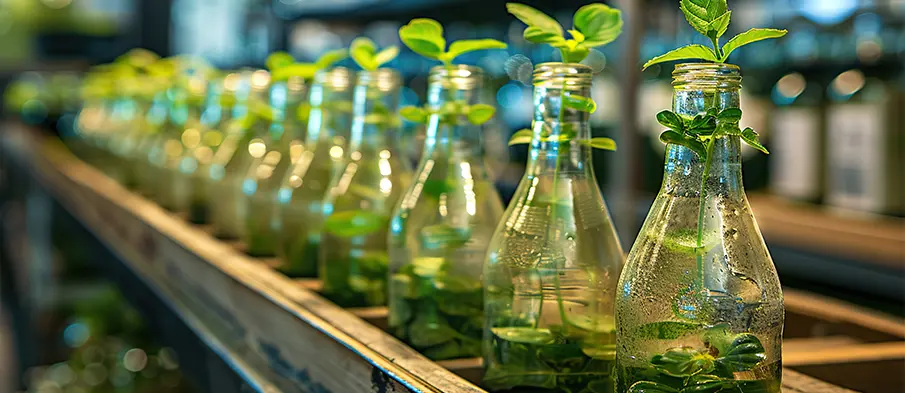
Glass, when deployed in a closed-loop, returnable system, fundamentally alters this equation. Refillable glass bottles reused across multiple cycles can reduce lifecycle emissions by 40–60% compared to single-use plastic. More importantly, they eliminate microplastic exposure from drinking water altogether—an emerging health concern that hospitality brands are only beginning to confront. Sustainability here ceases to be abstract. It is literally packaged in what the guest drinks.
This is where Glass Bottling Plants (GBPs) enter the hospitality narrative as quiet disruptors. Installed on-site or near-site, these systems purify bulk water, bottle it in sterilised glass, and circulate containers through controlled, returnable logistics loops. The operational shift is deceptively simple yet structurally transformative. Hotels that have adopted returnable glass bottling systems report 60–90% reductions in single-use plastic waste, 20–35% lower water procurement and logistics costs, and measurable declines in Scope 3 emissions linked to packaging and transport. In ESG terms, GBPs directly address one of hospitality’s most stubborn blind spots: outsourced pollution embedded in the supply chain.
The market is already rewarding this shift. According to a 2023 sustainability survey by Booking.com, 76% of Indian travellers express a preference for environmentally responsible stays, and over 40% indicate a willingness to pay a premium for hotels that demonstrate credible sustainability practices. Sustainability, in other words, has become a pricing lever, not merely a moral posture. Corporate travel policies—driven by ESG disclosures aligned with Global Reporting Initiative frameworks—are beginning to favour properties that can demonstrate Scope 3 emissions reductions, not just rooftop solar panels and linen-reuse cards. The procurement logic of large enterprises is slowly but decisively shifting from optics to outcomes.
The cultural change inside hospitality organisations is subtle but structural. When glass bottling plants are integrated into operations, sustainability stops being performative signage and becomes embedded system design. Plastic disappears quietly from the guest journey. Water becomes traceable. Procurement teams move from transactional buying to lifecycle thinking. Housekeeping and F&B operations become part of a circular economy loop rather than the end-points of a linear waste stream. What the guest experiences as “premium”—cool water in a heavy glass bottle—becomes a manifestation of invisible operational discipline.
There is also a reputational dividend. As regulators tighten plastic-waste rules and urban municipalities struggle with landfill capacity, hotels that pre-emptively decouple from single-use packaging position themselves as lower-risk partners for corporate clients, event organisers, and global hospitality alliances. In an era of real-time social media scrutiny, visible plastic waste in luxury spaces increasingly feels discordant, even regressive. The future brand language of hospitality will be written not just in marble lobbies and curated scents, but in the invisible infrastructure choices that reduce harm.
Indian hospitality will always sell comfort. That is its promise. The brands that will win the next decade are those that learn to sell comfort without consequences. In a water-stressed, carbon-accounted future, the most premium amenity may not be the view from the room—it may be the quiet assurance that your stay did not add a few more centuries to the planet’s cleanup bill.