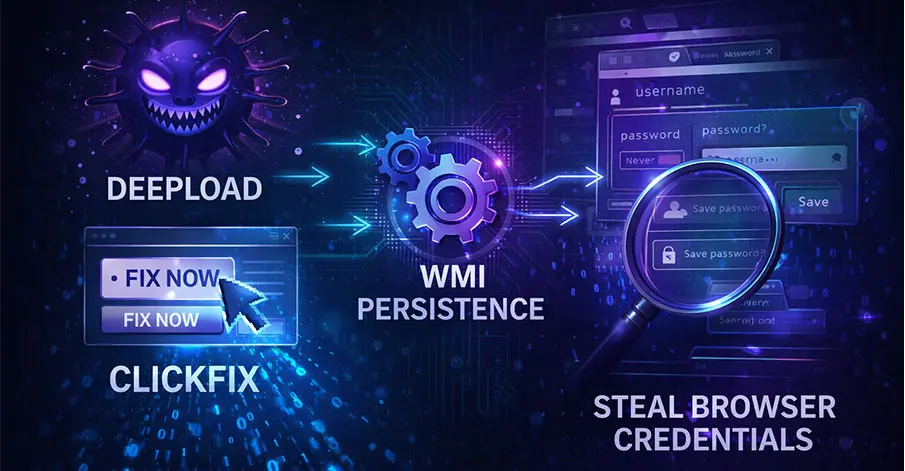
A newly identified malware campaign has introduced a sophisticated threat known as DeepLoad, which uses social engineering and advanced evasion techniques to steal sensitive user data. Cybersecurity researchers have found that the malware is being distributed through a tactic called ClickFix, where users are tricked into executing malicious commands under the guise of fixing a fake system issue.
The attack begins with deceptive prompts that convince users to paste a PowerShell command into the Windows Run dialog. Once executed, the command leverages legitimate system tools such as mshta.exe to download an obfuscated payload, allowing the malware to bypass traditional security defenses. This method relies heavily on user interaction, making it particularly effective in evading automated detection systems.
DeepLoad employs advanced techniques to remain hidden within infected systems. Researchers believe the malware uses AI-assisted obfuscation, generating large volumes of meaningless code to disguise its true functionality and avoid static scanning. It also injects malicious payloads into trusted Windows processes, enabling it to blend in with normal system activity and operate undetected.
One of the most concerning aspects of the malware is its ability to steal credentials immediately after infection. It extracts stored browser passwords, captures login data in real time through a malicious browser extension, and can even exfiltrate session information. In addition, the malware spreads through removable devices by disguising itself as legitimate software installers, increasing its reach across multiple systems.
DeepLoad also demonstrates strong persistence capabilities using Windows Management Instrumentation (WMI). Even after an infected system appears to be cleaned, the malware can reinfect the host days later without any user interaction by triggering hidden WMI event subscriptions. This allows attackers to maintain long-term access while avoiding detection by conventional cleanup methods.
The emergence of DeepLoad highlights the growing complexity of modern cyber threats, particularly those leveraging AI and fileless techniques. Security experts recommend continuous monitoring of system behavior, auditing WMI activity, and educating users about social engineering tactics like ClickFix, as traditional signature-based defenses may not be sufficient to detect or prevent such attacks.