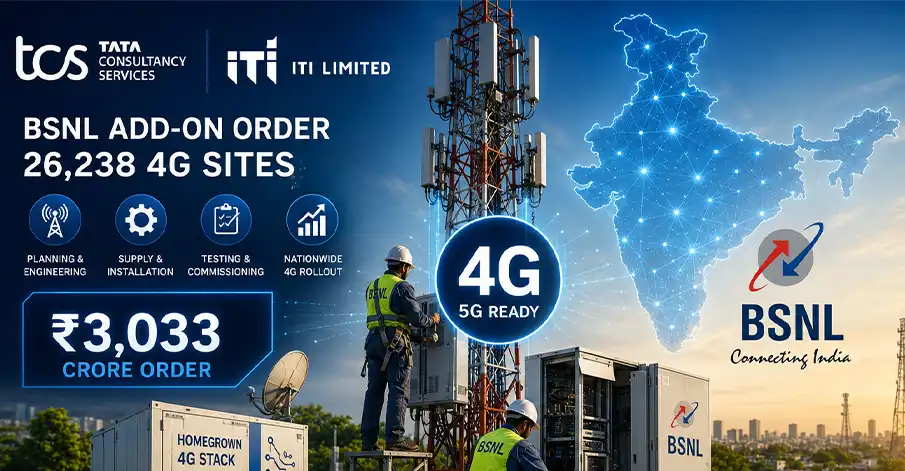
Tata Consultancy Services and state-run ITI Limited have received add-on orders from Bharat Sanchar Nigam Limited to supply 4G network equipment across 26,238 new locations at a cost of Rs 3,033 crore. The orders form part of BSNL’s commercial next-generation network rollout and cover planning, engineering, supply, installation, testing and commissioning of 4G network sites on a turnkey basis under the Phase IX.2 add-on project.
Under the latest order, TCS will supply equipment for 13,785 sites, while ITI will handle 5,314 sites. The scope includes the Northeast and South zones, including the Delhi licensed service area. ITI has also received work in the West zone, including Mumbai, under a 20% reservation quota. ITI Chairman Rajesh Rai said the company had received two orders for expansion of the 4G mobile network in the West zone, covering a total of 7,613 sites for an aggregate value of Rs 856.39 crore. The latest procurement follows an earlier award for 7,100 sites under the 4G Saturation programme.
The order is part of BSNL’s effort to modernise its mobile network with a homegrown 4G stack that is intended to be 5G-ready. BSNL also operates and maintains MTNL sites in Delhi and Mumbai, making the rollout relevant to metro as well as non-metro coverage. The public-sector operator’s average revenue per user stood at Rs 102.7 in Q1 FY26-27 on an unaudited basis, reflecting 3% sequential growth. Its enterprise business grew 19.2% year-on-year in the same quarter.
The vendor mix is important because India’s telecom infrastructure strategy has increasingly emphasised domestic capability, sovereign technology stacks and reduced reliance on foreign network equipment. TCS has been central to the systems integration layer of BSNL’s 4G rollout, while ITI brings public-sector telecom manufacturing and deployment capacity. The additional order indicates continued execution despite the complexity of deploying a national network across varied geographies.
For BSNL, the stakes extend beyond consumer mobile coverage. A 5G-ready 4G foundation can support enterprise connectivity, government communications, rural broadband expansion and future private-network services. The order also sits within the larger policy push to use public-sector demand to support indigenous telecom equipment ecosystems. Execution speed, site readiness, backhaul availability and service quality will determine whether the network upgrade translates into competitive gains, but the procurement itself marks another concrete step in BSNL’s delayed but strategically important network refresh.