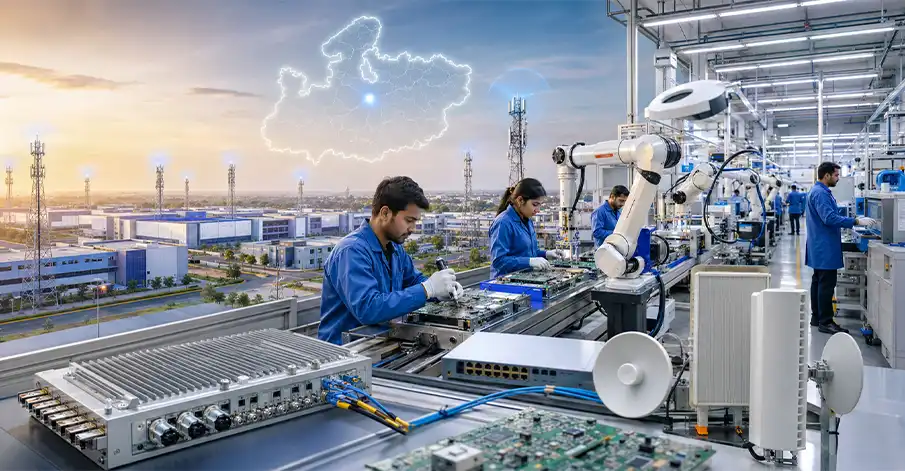


India has moved to establish its first Telecom Manufacturing Zone in Gwalior through a memorandum of understanding between the Department of Telecommunications and the Madhya Pradesh government’s Industries Department. The signing took place in the presence of Union Minister for Communications Jyotiraditya Scindia, Madhya Pradesh Chief Minister Mohan Yadav and Minister of State for Communications Chandrashekhar Pemmasani. Telecom Secretary Amit Agrawal said the zone is intended to help India progress from being one of the world’s largest telecommunications markets to becoming a centre for telecom design, development and manufacturing.
The first phase is expected to attract Rs 2,000 crore in investment and create more than 4,500 jobs. The broader target is at least Rs 10,000 crore in investment in the next stage. The zone is being positioned as a structured framework for a globally competitive telecom manufacturing ecosystem, with policy and institutional backing from the Centre and operational participation from the Madhya Pradesh government and industry. Agrawal said anchor investors had committed from the inception of the project, which the department sees as an early sign of confidence in the initiative.
The manufacturing zone is designed around multiple national priorities: domestic production, innovation, resilient supply chains, skilled employment and opportunities for local enterprises. These priorities have become more central as telecom networks increasingly intersect with cloud, edge computing, enterprise 5G, IoT, industrial connectivity and critical infrastructure security. Telecom equipment is no longer limited to tower and network gear; it is part of a broader stack that includes routing, optical transport, private networks, surveillance systems, edge devices and software-defined infrastructure.
The project also reflects a policy shift from generic electronics manufacturing toward more sector-specific industrial clusters. By anchoring the zone in telecom, the government is attempting to concentrate suppliers, investors, manufacturers, skilled labour and supporting institutions in a way that can shorten development cycles and reduce supply-chain fragmentation. The success of the zone will depend on the depth of manufacturing activity it attracts, the extent of design and R&D localisation, and whether Indian suppliers can move into higher-value telecom systems rather than remaining limited to assembly.
The Gwalior project also lands at a time when 5G network densification, private enterprise networks, rural broadband, satellite connectivity and early 6G research are all widening the strategic value of domestic telecom capability. For equipment makers and enterprise technology leaders, the zone will be watched for vendor participation, product categories, procurement linkages and export potential. Its first phase sets measurable investment and job markers; the harder milestone will be building a competitive supplier base that can serve both Indian network demand and international markets.