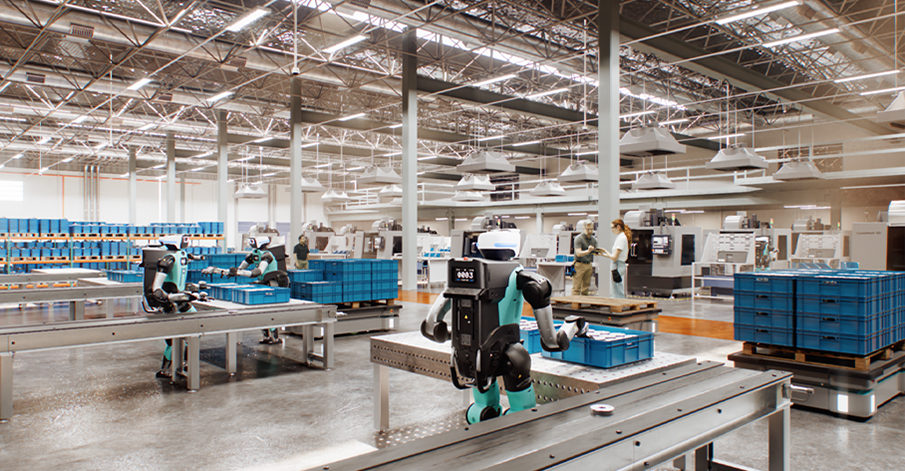
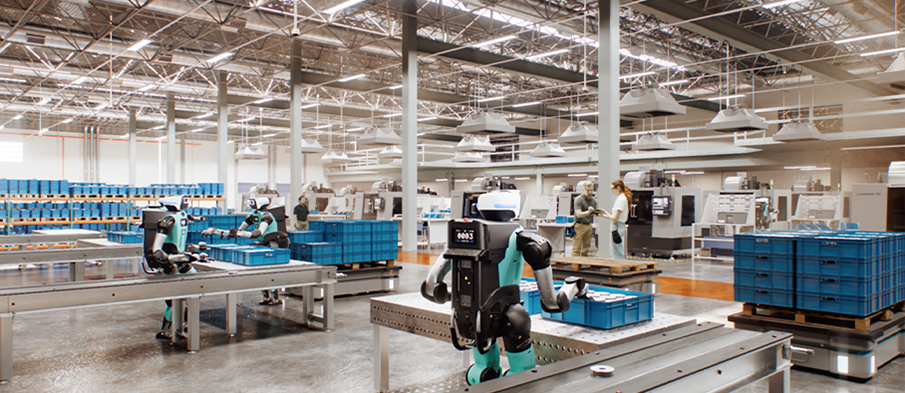
Agility Robotics has unveiled Digit 5, its next-generation humanoid robot designed to operate in close proximity to human workers without the physical safety barriers traditionally used with industrial robots. The new robot introduces a safety system that can detect nearby people and autonomously change its movements, including avoiding a person, stopping, or moving into a seated position when someone gets too close.
The new humanoid is being positioned by Agility as a step toward deploying robots in industrial environments where humans and machines need to work in the same areas. The company said Digit 5 is its first humanoid robot engineered for “cooperatively safe work at scale,” building on more than 65,000 hours of commercial operation accumulated by earlier Digit robots.
Digit 5 uses AI algorithms and multiple sensor technologies to continuously monitor its surroundings for people. When it detects a person at a distance, the robot can adjust its movement to avoid them or stop and allow them to pass. If a person comes into close proximity, Digit 5 can assume a seated position as another safety response.
According to Agility, the robot’s safety architecture includes an independent safety controller that oversees its response when a person enters an unsafe distance. The system is also designed to provide visual and auditory cues indicating the robot’s movement and intent.
The company has integrated NVIDIA IGX Thor hardware into Digit 5 and is using NVIDIA’s Halos for Robotics safety framework as part of the robot’s computing and safety architecture. Agility said it is the first launch partner for NVIDIA’s Halos for Robotics platform.
The focus on human-robot interaction addresses one of the challenges involved in deploying humanoid robots in warehouses and manufacturing facilities. Traditional industrial automation often relies on physical barriers or dedicated robot cells to separate machines from workers. Digit 5 is being designed to reduce that dependence, allowing it to move through areas where employees may also be working.
Beyond safety, Agility has upgraded Digit 5’s physical capabilities. The robot can repeatedly lift loads of up to 50 pounds (22.7 kilograms), representing a 40% increase in payload capability over the previous generation. Its new leg design is intended to support repetitive lifting tasks in industrial environments.
Digit 5 also features a new battery system that can operate for around 90 minutes before requiring a recharge. Agility said the robot can recharge in approximately nine minutes, giving it a 10:1 run-to-charge ratio. The company estimates that this configuration can enable more than 20 hours of productive operation during a 24-hour period.
The humanoid stands 5 feet 11 inches tall, weighs 284 pounds (129 kilograms) and can reach heights of up to 7.2 feet. Its human-scale dimensions are intended to allow it to operate in aisles, workstations and other spaces designed for people.
Another upgrade is a swappable gripper system that allows different end-effectors to be installed for specific tasks. Agility said this will expand Digit 5 beyond the tote-handling work associated with earlier versions, with potential applications including depalletising, machine tending, kitting, sequencing, quality inspection and palletising.
Agility has already deployed earlier versions of Digit commercially. The company said Digit 4 has accumulated more than 65,000 hours of operation across customer sites in North America, including deployments involving GXO, Schaeffler, Amazon and Toyota Motor Manufacturing Canada. At GXO’s Flowery Branch facility near Atlanta, Digit 4 has reached a cumulative milestone of 100,000 totes handled while maintaining approximately 98% accuracy while on-task, according to Agility.
The company also said it had more than $300 million in multi-year customer orders for Digit 5 as of May 2026, subject to certain contractual milestones. Its customer pipeline includes companies in manufacturing, warehousing and logistics.
Agility is also participating in efforts to develop safety standards