

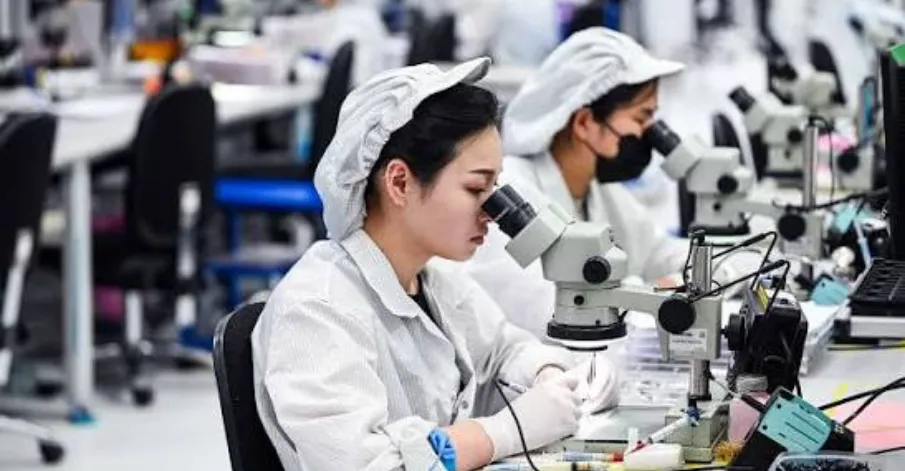
Singapore is expanding the use of artificial intelligence in scientific research and industrial development through a new initiative backed by an initial government investment of S$150 million (US$117 million). Called MARVEL-AI, the programme aims to combine advanced AI models with automated laboratories to accelerate materials discovery and development.
The initiative, led by the Agency for Science, Technology and Research (A*STAR), was announced on October 27, 2026, at the Singapore Week of Innovation and Technology (SWITCH) 2026. It is intended to shorten research and development processes and help move scientific discoveries towards commercially viable products.
Professor Loh Xian Jun, executive director of A*STAR’s Institute of Materials Research and Engineering, said AI and automation could reduce the time required for materials discovery by up to 10 times. The technologies can help researchers process validation and characterisation more quickly, develop different material combinations and screen them for specific properties.
One example is a hydrogel developed by Professor Loh and his research team that could potentially be used to treat retinal detachment. The material remains liquid at room temperature but turns into a hydrogel when injected into the eye at body temperature. AI-assisted platforms have helped researchers speed up the process of fine-tuning its composition.
Researchers are also exploring ways to convert wood waste into components typically obtained from fossil fuels, which could reduce waste and dependence on petroleum-based products. However, scaling laboratory discoveries into industrial production remains a challenge, particularly when factors such as heat and mass transfer become difficult to predict.
Under MARVEL-AI, companies will be able to work with researchers on solutions for specific industrial problems.
AI is also changing the development of complex industrial equipment. Jacomo Corbo, CEO and co-founder of engineering and deep-tech AI company PhysicsX, said AI could accelerate simulations used to test and refine designs by factors of 10,000 or 100,000, and in certain cases, almost a billion times. He said the company’s work in semiconductor equipment manufacturing had helped reduce the development time for a new machine by almost 20 per cent.
However, Corbo cautioned that AI-generated results still require validation, particularly in industries where design failures could have serious consequences.
Turning research into successful businesses also requires leadership, investment and intellectual property protection, according to Howard Wright, Nvidia’s vice-president of startup ecosystem. He said AI has made technical capabilities more accessible to entrepreneurs but advised startups to plan their funding carefully and look beyond their domestic markets.
Wright said Nvidia works with more than 1,000 startups in Singapore, pointing to the country’s engineering talent, universities and access to investment capital as strengths.