


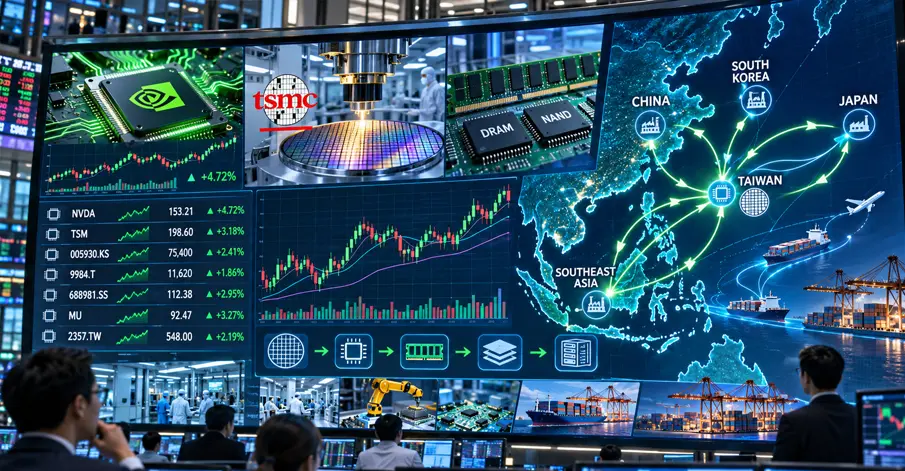
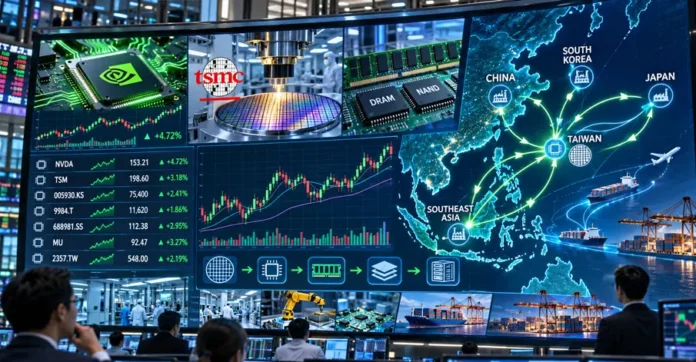
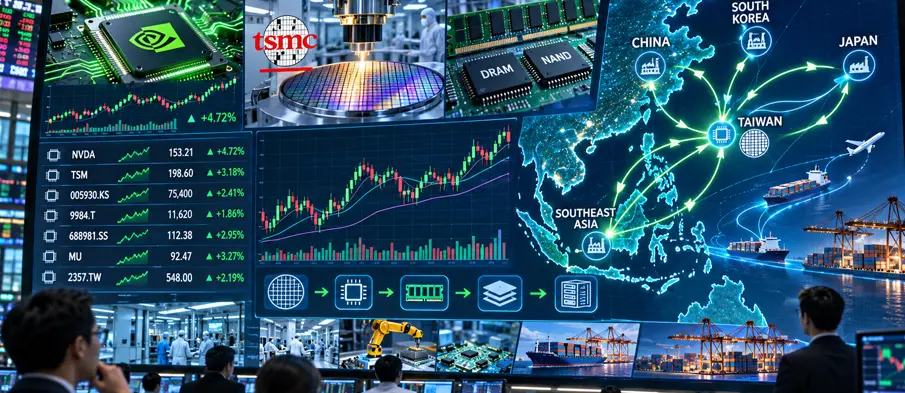
Asian technology stocks declined sharply as investors reassessed the outlook for the artificial-intelligence hardware market following leadership turmoil at Nvidia. The sell-off extended weakness in US technology shares and placed renewed attention on the degree to which regional equity markets depend on semiconductor and AI-infrastructure valuations.
Taiwan’s Taiex fell approximately 6%, while Taiwan Semiconductor Manufacturing Company declined 5.7%. TSMC manufactures advanced processors for Nvidia and other leading chip designers, making it a direct indicator of expectations for future accelerator demand. Technology and semiconductor shares also weighed on markets in South Korea and Japan.
The decline followed a 0.9% fall in the Nasdaq Composite. US equity futures were also lower during Asian trading. Nvidia’s leadership crisis has added company-specific uncertainty to existing questions about the pace of AI capital expenditure, the financing of data-centre projects and the ability of customers to turn infrastructure spending into sustainable revenue.
Markets were awaiting Nvidia’s quarterly results, scheduled for 17 November, for updated information on orders, production capacity, product transitions and the effect of export restrictions. Anthropic’s planned public-market debut later in the week was another major test of investor demand for highly valued AI businesses.
The market movement did not indicate an immediate reduction in physical semiconductor orders. It instead reflected repricing across companies whose valuations have become closely connected to assumptions about AI demand. Asian exchanges contain several of the world’s most important foundries, memory manufacturers, packaging businesses and production-equipment suppliers, causing changes in US AI expectations to travel rapidly through regional markets.
The episode also demonstrates the concentration of the current technology supply chain. Nvidia designs the dominant accelerator platform, while a limited group of Asian manufacturers provide leading-edge fabrication, high-bandwidth memory and advanced packaging. Disruption or uncertainty involving any major participant can therefore affect a much larger group of listed suppliers.
Further direction will depend on Nvidia’s financial disclosure, the progress of its CEO search and evidence of continued capital spending from hyperscale-cloud and model-development companies.



