


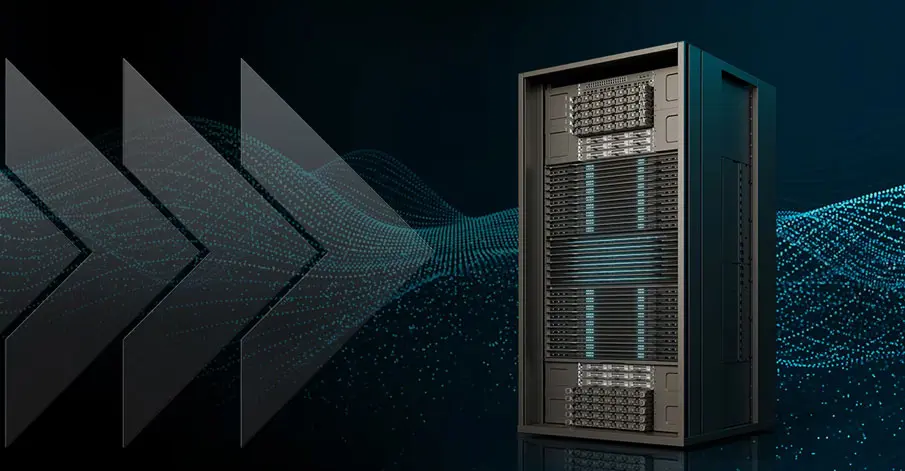
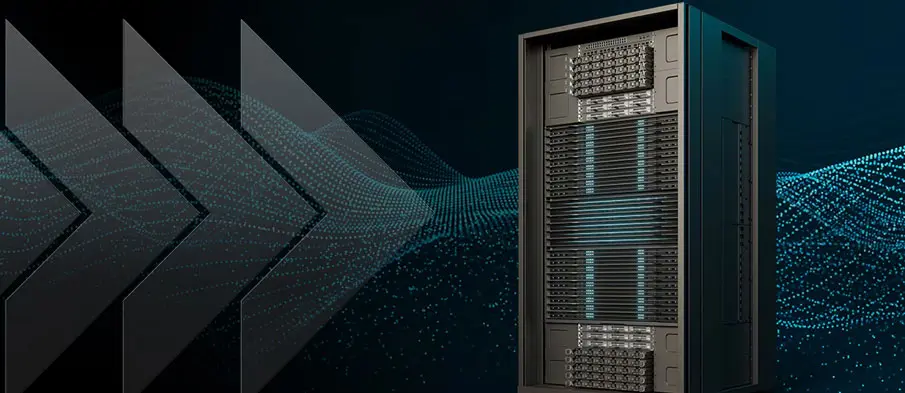
AMD used its CES 2026 keynote to signal a major leap in its data center and AI strategy, unveiling the Helios AI Rack as its flagship platform for next-generation AI computing. Built around the EPYC Venice “Zen 6” CPU and the Instinct MI455X GPU, Helios represents AMD’s first major system-level product in the 2nm era. First introduced at the company’s Financial Analyst Day in 2025, the rack is designed as a fully liquid-cooled solution purpose-built for large-scale AI workloads, with AMD positioning it as class-leading in both efficiency and performance density.
Helios is not a conventional server configuration but a tightly integrated AI platform engineered for scale. Each rack combines four Instinct MI455X GPUs with a single EPYC Venice “Zen 6” processor, alongside the Pensando “Salina” 400 data processing unit and the Pensando “Vulcano” 800 AI network interface card. Together, these components form a highly interconnected system capable of scaling up to 2.9 exaflops of compute. The platform is further reinforced by massive HBM4 memory capacity and bandwidth, targeting the most demanding training and inference workloads in modern AI systems.
AMD chair and CEO Dr. Lisa Su emphasized the sheer physical and computational scale of the system during the keynote. “Helios is a monster of a rack,” she said. “This is no regular rack, okay. This is a double wide design based on the OCP open rack wide standard developed in collaboration with Meta, and it weighs nearly 7,000 pounds.” Highlighting the power density involved, she added, “We wanted to show you what is really power in all this AI, it is actually more than two compact cars.”
Beyond the rack itself, Su used Helios to showcase AMD’s broader transition to 2nm manufacturing. The system serves as a central pillar of the company’s next-generation roadmap, spanning EPYC Venice CPUs—scaling up to 256 cores—and Instinct MI400-series GPUs equipped with next-generation HBM4 memory stacks. By anchoring these advances within a rack-scale solution, AMD is signaling a shift toward delivering complete, end-to-end AI infrastructure rather than standalone chips.
With Helios, AMD is offering a preview of how it intends to compete at the highest levels of data center computing. The rack underscores the company’s focus on performance, density, and system-level optimization as AI workloads continue to grow in size, complexity, and energy demands.


