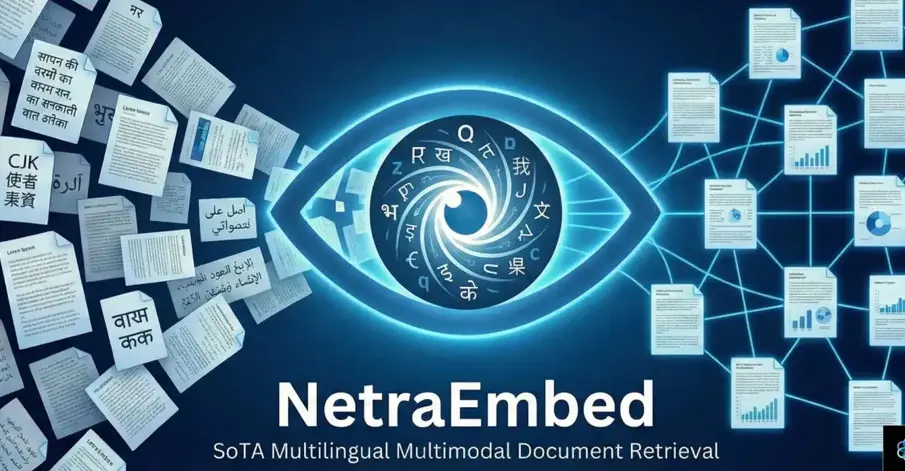

CognitiveLab has shaken up the global document AI space with the launch of NetraEmbed, a multimodal multilingual retrieval model that outperforms existing baselines by 150 percent and supports 22 languages. “A one of a kind SoTA multimodal multilingual document retrieval model,” according to founder Adithya S Kolavi, NetraEmbed is designed to make large-scale cross-lingual document search production-ready, a task that has long remained challenging in the industry.
The model achieves a score of 0.716 on cross-lingual tasks and 0.738 on monolingual search, positioning it at the forefront of document retrieval technology. Unlike conventional models that focus solely on text, NetraEmbed processes documents as images, preserving critical visual elements such as charts, tables, and layout. At the same time, it produces compact 10 KB embeddings, making large-scale indexing feasible for enterprises handling vast multilingual datasets.
In addition to NetraEmbed, CognitiveLab has introduced ColNetraEmbed, which offers token-level explanations and flexible embedding sizes. This extension further enhances interpretability and adaptability, allowing organizations to tailor the model’s outputs for complex retrieval and analytical workflows.
The release coincides with the launch of the NayanaIR benchmark, which includes 23 datasets, and the M3DR research paper, reflecting CognitiveLab’s broader efforts under the Nayana initiative for multilingual, multimodal document intelligence. According to the company, future models in this initiative aim to push capabilities beyond retrieval into deep document understanding and cross-lingual question answering, promising even more advanced AI-driven insights.
With NetraEmbed, CognitiveLab is addressing a long-standing gap in AI-driven document search: delivering robust performance across languages while maintaining the structural integrity of documents. By combining multimodal processing, efficient embeddings, and interpretability, the model sets a new standard for enterprises and researchers looking to harness document AI at scale.