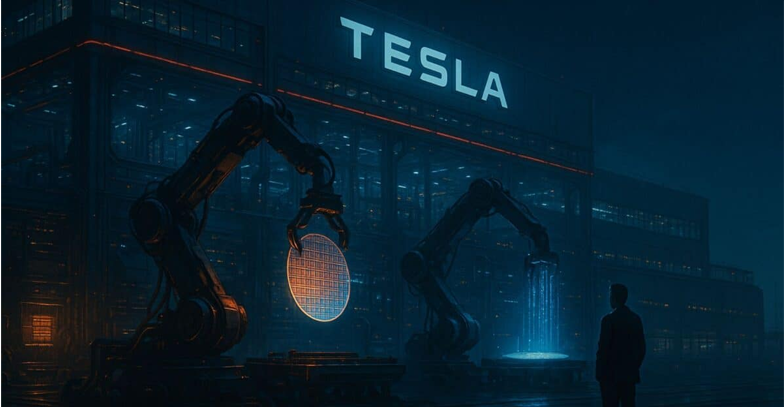
Elon Musk has introduced an ambitious semiconductor manufacturing initiative called “Terafab,” a large-scale AI chip factory project designed to support the growing technological needs of Tesla, SpaceX, and xAI. The facility is expected to be developed in Austin, Texas, and aims to significantly boost chip production capacity for applications in artificial intelligence, robotics, autonomous vehicles, and space-based computing.
The Terafab project is envisioned as a vertically integrated “mega-fab” that will bring together multiple stages of chip production—including design, manufacturing, testing, and packaging—under one roof. This integrated approach is intended to accelerate innovation cycles by allowing rapid iteration, reducing dependency on external suppliers, and enabling tighter control over performance and cost.
A key motivation behind the initiative is the anticipated shortage of advanced semiconductors required for Musk’s expanding ecosystem. Tesla’s plans for autonomous driving, robotaxis, and humanoid robots, along with SpaceX’s ambitions for AI-powered satellite networks and space infrastructure, are expected to drive unprecedented demand for high-performance chips. Musk emphasized that current global chip production is insufficient to meet these future requirements, making in-house manufacturing a strategic necessity.
The project will reportedly focus on developing specialized chips for different use cases. One category will cater to Tesla’s vehicles and robotics systems, while another will support AI workloads in space, where chips must operate under extreme environmental conditions such as high temperatures and radiation. This dual-focus approach reflects Musk’s broader vision of extending AI capabilities beyond Earth-based data centers.
In terms of scale, Terafab is projected to eventually deliver up to one terawatt of computing capacity annually, a figure that could surpass the current output of existing infrastructure in the United States. While the timeline for full-scale operations remains unclear, early phases of the project are expected to begin with smaller prototype facilities that can rapidly test and refine manufacturing processes.
Despite its transformative potential, the initiative faces significant challenges, including high capital investment, complex supply chains, and the technical difficulty of building advanced semiconductor fabrication facilities. Industry experts have described such projects as highly demanding, often requiring billions of dollars and years of development to reach maturity.
Terafab represents a major step toward vertical integration for Musk’s companies, aiming to secure critical hardware supply while pushing the boundaries of AI and computing infrastructure. As global competition intensifies in semiconductor manufacturing, the project highlights a growing trend among tech leaders to invest heavily in proprietary chip ecosystems to support next-generation innovations
- Advertisement -