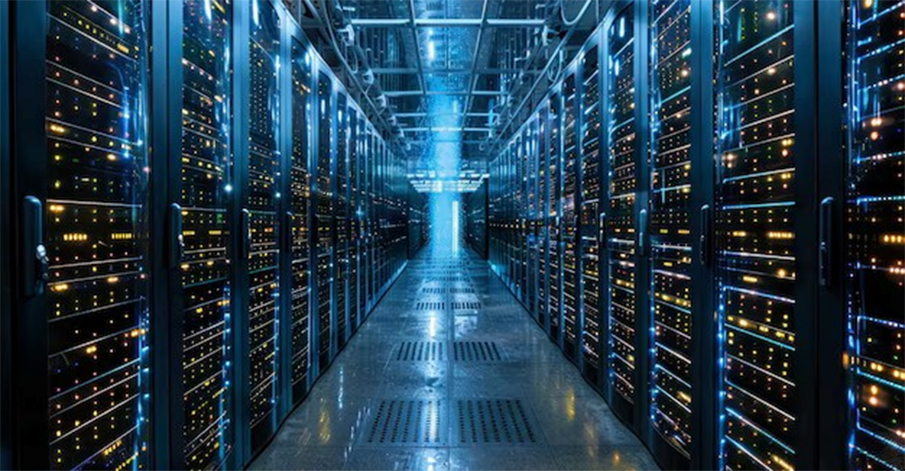
Minnesota — In a major step toward sustainable and resilient cloud infrastructure, Google revealed that its forthcoming data centre will be backed by what’s expected to be the world’s largest battery energy storage system, capable of providing up to 100 hours of continuous power backup.
The breakthrough comes as part of Google’s push to reduce reliance on traditional backup power sources — such as diesel generators — and expand the use of renewable energy in powering its sprawling network of data centres that support services like Search, YouTube, Maps and Workspace.
A New Era of Long-Duration Storage
Unlike typical lithium-ion battery systems that can store energy for only four to eight hours, the cutting-edge storage solution is based on iron-air battery technology developed by Form Energy. These batteries use a reversible chemical process in which iron oxidises (rusts) when discharging electricity and is “de-rusted” (reduced) when recharging — a method that allows extended storage durations at significantly lower cost than traditional lithium-ion systems.
Form’s iron-air batteries are expected to deliver 300 megawatts of capacity with roughly 30 gigawatt-hours (GWh) of storage, which translates to about 100 hours of backup power — enough to bridge multi-day gaps in renewable generation caused by prolonged periods without sun or wind.
Why 100-Hour Backup Matters
Modern data centres, especially those supporting AI workloads, must operate 24/7 without interruption. Power interruptions — even short ones — can jeopardise critical digital services and data integrity. By integrating long-duration storage that can withstand days without grid power or renewable generation, Google aims to dramatically improve reliability and sustainability.
This move also marks one of the first major deployments of long-duration energy storage at such a large scale, suggesting a shift in how the technology could be used across industries that require persistent power supply — from cloud computing hubs to grid-level renewable integration.
A Broader Clean Energy Strategy
The battery system will be paired with renewable energy generation — including wind and solar power — as part of a comprehensive plan to support the data centre’s electricity needs with low-carbon sources. As part of the agreement with utility partner Xcel Energy, Google will add roughly 1,400 MW of wind and 200 MW of solar capacity to the local energy mix, helping ensure that clean energy is available when needed and that long-duration storage can complement intermittent renewables.
Under a regulatory framework called the Clean Energy Accelerator Charge, Google will finance these clean energy assets directly, enabling the build-out of new generation and storage without passing costs on to local ratepayers.
A Milestone for Renewable Backup Technology
At 30 GWh, the battery project — worth close to $1 billion — becomes the largest announced long-duration storage deployment worldwide, dwarfing previous grid battery installations in capacity and scale.
Industry experts say that achieving truly multi-day storage at commercial scale has been a critical missing piece in mainstreaming renewable energy for continuous operations. By investing in iron-air technology, Google is helping demonstrate how renewable power, when combined with affordable long-duration storage, can rival traditional fossil-fuel-based backup systems even in demanding applications like AI data centres.
Looking Ahead
The battery system is expected to be installed by 2028 alongside the data centre in Pine Island, Minnesota. If successful, the deployment could set a precedent for how hyperscale cloud infrastructure tackles the twin challenges of energy reliability and carbon reduction — not just with short bursts of stored energy, but with days’ worth of clean backup power.