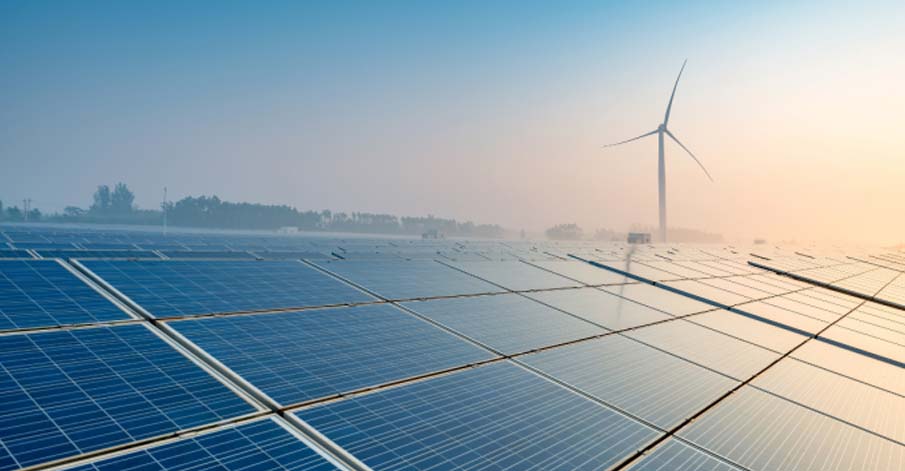
2025 has emerged as a defining year for India’s energy transition, with the country achieving 50% non-fossil fuel–based installed electricity capacity five years ahead of its Nationally Determined Contribution (NDC) commitment.
Against a stated target of 500 GW of non-fossil capacity by 2030, India’s combined installed and pipeline non-fossil capacity stood at approximately 507 GW in 2025. Over the years, total non-fossil capacity has risen from 81 GW to 263 GW, marking a growth of 225%.
Solar Power Drives the Transition
Solar energy has been the primary driver of this expansion. Since 2014, installed solar capacity has surged from 2.8 GW to 133 GW, representing an increase of 4,550%. This growth has been supported by large-scale utility projects, rooftop solar adoption, and hybrid renewable energy tenders.
Government initiatives have also played a critical role. Schemes such as PM Surya Ghar: Muft Bijli Yojana, which aims to provide rooftop solar connections to one crore households, have significantly accelerated capacity addition across residential segments.
Wind, Bioenergy, and Global Standing
Wind energy has recorded steady growth, with installed capacity rising from around 21 GW to 54 GW since 2014, an increase of 155%. Bioenergy capacity has expanded from 8.1 GW to 12 GW, registering a growth of 42%, supported by increased utilisation of agricultural residue and organic waste.
Between 2022 and 2024, India emerged as the third-largest contributor to global solar capacity additions, adding approximately 46 GW of solar power during this period.
Government View on the Milestone
Minister for New and Renewable Energy Pralhad Joshi, in a social media post in July 2025, said that as the world searches for solutions to climate change, India is leading by example. He added that achieving 50% non-fossil fuel capacity five years ahead of the 2030 target is a proud moment for the country and credited the leadership of Narendra Modi for guiding India’s green transformation toward a self-reliant and sustainable future.
Manufacturing Capacity Scales Up
Alongside generation capacity, renewable energy manufacturing has also seen rapid progress. Domestic production has strengthened supply chains and reduced dependence on imports.
Solar module manufacturing capacity expanded from 2 GW to 123 GW, a growth of over 6,000%. Solar cell manufacturing, which was negligible before 2014, has now reached 27 GW, while wafer manufacturing capacity stands at 2.2 GW. India has also established 3.2 GW of fully integrated manufacturing facilities, covering the entire solar value chain.
Global Recognition and Cost Savings
India’s clean energy push has gained strong international recognition. In 2023, the country became the world’s third-largest solar power generator, overtaking Japan, with solar electricity generation of 1,08,494 GWh.
According to International Renewable Energy Agency (IRENA), India’s clean energy transition has resulted in savings of nearly ₹4 lakh crore, or about $46 billion, in fossil fuel and pollution-related costs. Of this, fossil fuel savings alone account for approximately $14.9 billion.
Storage Takes Centre Stage
In 2025, energy storage moved from being viewed as a future requirement to becoming a core enabler of renewable growth. The government rolled out policy support for Battery Energy Storage Systems (BESS), including viability gap funding for grid-scale projects.
At the same time, pumped storage projects regained policy focus, with multiple projects at various stages of planning and approval across states—highlighting India’s efforts to ensure grid stability alongside rapid renewable capacity addition.