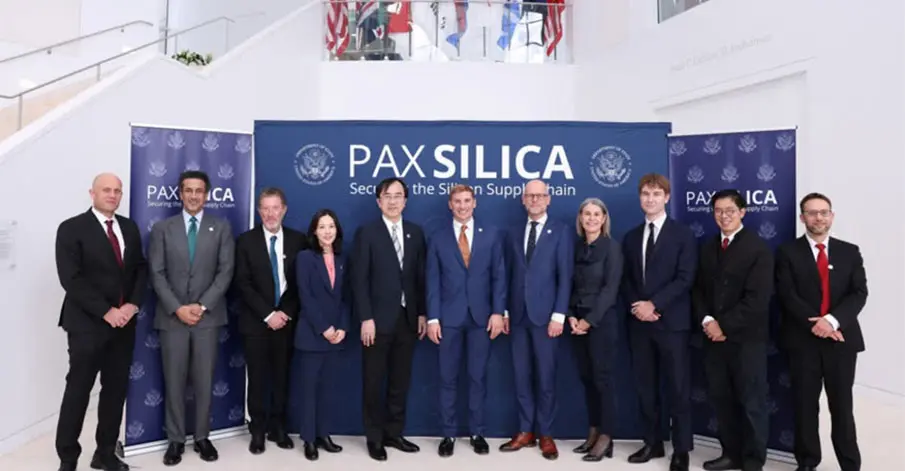
India formally joined the Pax Silica initiative — a US-led effort focused on artificial intelligence and secure supply chains — on the sidelines of the India AI Impact Summit 2026 being held in the national capital.
The Pax Silica Declaration was signed and exchanged in the presence of Jacob Helberg, United States Under Secretary of State for Economic Growth, Energy, and the Environment; US Ambassador to India Sergio Gor; and S Krishnan, Secretary, Ministry of Electronics and Information Technology. Union Minister for Electronics and Information Technology Ashwini Vaishnaw and Google CEO Sundar Pichai were also present at the event.
Pax Silica is the US Department of State’s flagship initiative on AI and supply chain security, aimed at building a new economic security consensus among allies and trusted partners. The name combines “Pax” (Latin for peace) and “Silica” (referencing silicon chips), symbolising a stable, cooperative and peaceful technological order. The coalition seeks to secure the entire AI technology stack — from mineral extraction and silicon wafer production to advanced manufacturing, logistics and AI systems — while reducing coercive dependencies and strengthening economic resilience.
Addressing the gathering, Helberg underscored the broader geopolitical and economic context behind the initiative. “We watch as our friends and allies face daily threats of economic coercion and blackmail, forced to choose between their sovereignty and their prosperity. We find ourselves grappling with a global supply chain that is massively over-concentrated.”
“So today, as we sign the Pax silica declaration, we say no to weaponised dependency, and we say no to blackmail, and together, we say that economic security is national security, but we must be precise about what that word means.” He added, “We are forging a supply chain that is the foundation for prosperity. We are building a new architecture that diffuses intelligence, placing the awesome power of AI into the palms of our people’s hands and unleashing a wave of unprecedented possibilities from the minds to the models. We are securing the full stack of the future, the minerals deep in the earth, the silicon wafers in our labs and the intelligence that will unleash human potential.”
Calling Pax Silica a forward-looking commitment, Helberg said, “Pax Silica is our declaration that the future belongs to those who build and when free people join forces, we do not wait for the future to be given to us. We build it ourselves.”
He also praised US Ambassador Sergio Gor for helping deepen ties between New Delhi and Washington, describing it as a testament “to the vital importance that the United States places on this friendship.”
The declaration itself highlights the importance of trusted supply chains and the transformative role of AI. “We recognise that a reliable supply chain is indispensable to our mutual economic security. We also recognise that artificial intelligence (AI) represents a transformative force for our long-term prosperity and that trustworthy systems are essential to safeguarding our mutual security and prosperity,” reads the Pax Silica Declaration.
India’s participation follows its recent engagement at the Critical Minerals Ministerial convened by US Secretary of State Marco Rubio earlier in February, where the country was represented by External Affairs Minister S Jaishankar.
During his visit, Helberg is also scheduled to hold bilateral meetings and deliver remarks aimed at strengthening the United States’ economic relationship with India in emerging technologies. He will help launch the next phase of the American AI Exports Program, part of the broader AI Action Plan.
India’s formal entry into Pax Silica signals closer collaboration with the United States on AI governance, supply chain resilience, and economic security at a time when technological leadership and strategic autonomy are increasingly intertwined.