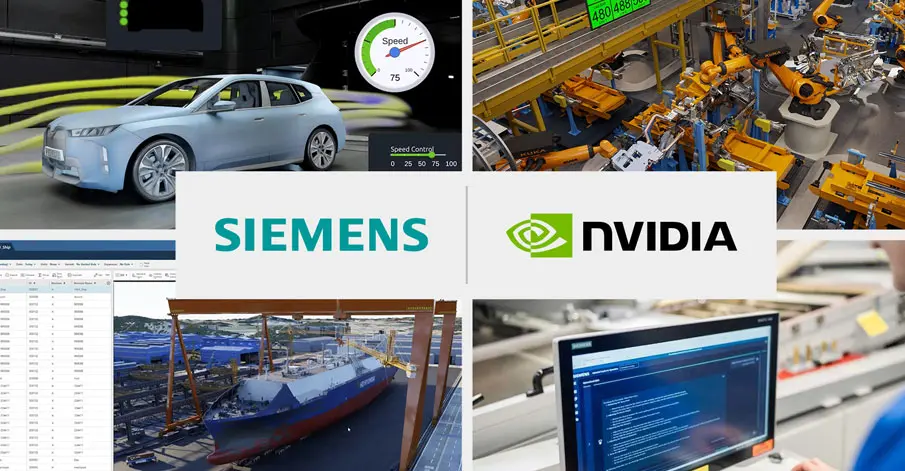
Siemens and NVIDIA have announced a major expansion of their long-standing strategic partnership, signaling a decisive push to embed artificial intelligence directly into real-world industrial environments. The collaboration is focused on developing industrial and physical AI solutions that move beyond digital experimentation, enabling AI-driven innovation across manufacturing, infrastructure, and multiple heavy industries while accelerating both companies’ operational capabilities.
At the center of the partnership is a shared vision to transform how the physical world is designed, built, and operated. Roland Busch, President and CEO of Siemens AG, underscored this ambition, stating, “Together, we are building the Industrial AI operating system — redefining how the physical world is designed, built and run — to scale AI and create real-world impact.” The goal is to make AI a foundational layer of industrial systems, rather than a standalone digital tool.
NVIDIA’s role brings advanced accelerated computing and generative AI into Siemens’ industrial software ecosystem. Jensen Huang, founder and CEO of NVIDIA, highlighted the scale of the shift underway: “Generative AI and accelerated computing have ignited a new industrial revolution, transforming digital twins from passive simulations into the active intelligence of the physical world.” By combining NVIDIA Omniverse libraries with Siemens’ industrial operations software, factories can continuously analyze digital twins, simulate improvements in virtual environments, and translate proven insights directly onto the shopfloor.
This closed-loop approach allows manufacturers to move faster from design to deployment, reducing risk while improving efficiency, quality, and reliability. AI-powered digital twins will evolve from static models into living systems that adapt in near real time, enabling more responsive decision-making across production lines and supply chains.
Beyond factory operations, the expanded partnership will also advance semiconductor design, AI factories, and next-generation manufacturing facilities. Siemens plans to complete GPU acceleration across its simulation portfolio and broaden support for NVIDIA CUDA-X libraries and AI-based physics models, strengthening performance and scalability for complex industrial workloads.
Looking ahead, the companies aim to develop what they describe as the world’s first fully AI-driven, adaptive manufacturing sites. This vision will begin taking physical form in 2026, with the Siemens Electronics Factory in Erlangen, Germany, serving as the first blueprint. The initiative marks a significant step toward making AI a core driver of industrial productivity and innovation at global scale.