


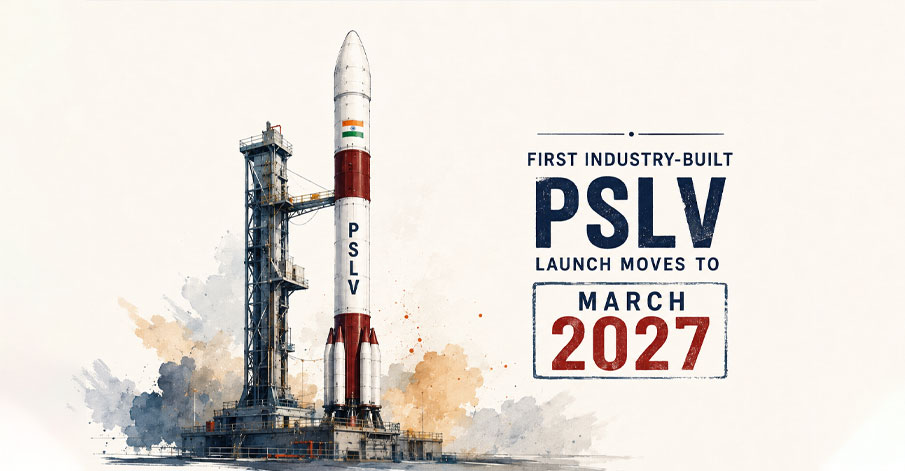
The maiden launch of the first Polar Satellite Launch Vehicle (PSLV) assembled under India’s industry-led production programme has been pushed to March 2027. The revised schedule extends the timeline for a programme aimed at transferring end-to-end production of the established launch vehicle to a private-sector consortium.
NewSpace India Limited awarded the production contract in 2022 to a consortium led by Hindustan Aeronautics Limited (HAL) and Larsen & Toubro (L&T). The order covers five PSLV-XL vehicles, with the Indian Space Research Organisation (ISRO) providing technical support. The programme seeks to expand the role of Indian industry from supplying individual components and subsystems to taking responsibility for the manufacturing, assembly, integration and delivery of complete launch vehicles.
The inaugural vehicle, generally referred to as PSLV-N1 within the production programme, has gone through several revised launch targets. Stacking of its first stage began at the Satish Dhawan Space Centre on December 22, 2025, with the initial objective of launching during the first quarter of 2026. The latest March 2027 target creates a significantly longer gap between the start of stacking and the planned flight.
No specific reason for the latest schedule revision has been publicly detailed in the current update. Launch timelines can be influenced by vehicle integration, testing, payload readiness, range availability and mission-level reviews. However, attributing the delay to any particular factor would be premature without a formal explanation from NSIL, ISRO, HAL or L&T.
The PSLV is a four-stage launch vehicle that uses alternating solid- and liquid-propellant stages. It has been one of India’s primary launch platforms for Earth-observation, navigation, scientific and commercial missions. The PSLV-XL configuration uses six extended strap-on motors to increase its lift capability.
Producing the vehicle through industry requires consortium partners to manage a broad supply chain covering structures, propulsion materials, avionics, actuators, sensors, wiring, batteries, mechanical interfaces and quality-control procedures.
The programme had already reached several industrial milestones before the latest schedule change. The consortium delivered solid-propellant ingredients for the inaugural vehicle and received detailed technical inputs covering component procurement, avionics quality control, testing and integration. ISRO has described the five-vehicle order as part of a broader effort to increase industry participation while enabling the agency to focus more resources on research, advanced missions and new launch systems.
The revised schedule does not change the scope of the five-rocket contract, but it postpones the programme’s key validation point: the first operational flight of a PSLV produced through the industry consortium. The demonstration is significant for NSIL’s efforts to expand launch capacity and develop Indian companies capable of serving as full launch-vehicle system integrators. Until the maiden vehicle completes its flight, the production model remains in its validation phase despite the hardware and integration work already completed.


 assembled under India’s industry-led production programme has been pushed..)