





The Optimizely incident shows why a script you didn’t write can still be your breach.
178 organisations woke up this week to find that a tool their marketing team uses for A/B testing had become a card skimmer. Nobody had phished their staff or breached their servers. The attacker came in through a vendor script that their own websites loaded without a second thought.
Think of it as hiring a reputable caterer for your wedding and finding the caterer’s van has been used to smuggle someone else’s cargo into the venue. You vetted the caterer. You never checked the van.
What happened
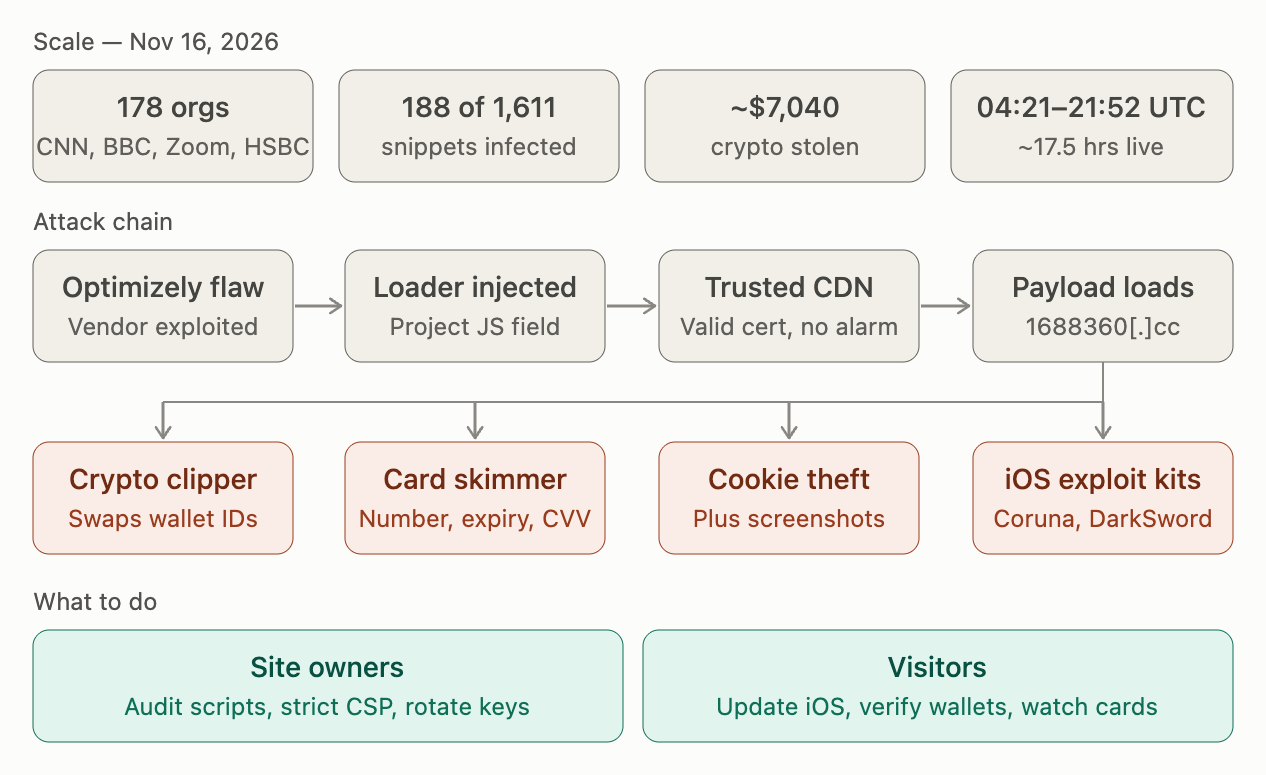
On 16 November, an attacker exploited a flaw in Optimizely Web Experimentation and injected JavaScript into customer snippets. The flaw has not been described publicly, and no CVE or count has been confirmed by Optimizely. Report URI found the malicious code in 188 snippets belonging to 178 organisations. The names reported include HSBC, Equifax, BBC, CNN, Zoom, Salesforce and Vodafone Australia. Banking and finance was the largest group, with 32 organisations.
The code did three things. It swapped crypto wallet addresses, it skimmed card data typed into the sites’ own forms, and it served iOS exploit kits to older iPhones. On that last point, a note of caution: one security firm, Cynet, says no physical iPhone compromise has been confirmed, so treat the iOS angle as reported delivery, not proven damage. Estimates of the attacker’s take differ too, at roughly $7,040 by Report URI and $6,600 by StepSecurity. Optimizely says it has fixed the flaw and removed the code.
Only 15% of the hosts checked blocked the payload through their content security policy. That is the number I keep coming back to.
Why this matters for Indian boards and CISOs
Indian BFSI runs on the same pattern. Banks, NBFCs, insurers and fintechs load analytics, personalisation, chat and testing scripts onto pages where customers type card numbers, UPI details and KYC data. Marketing owns many of those tags. Security often doesn’t know the full list.
That gap is a governance problem, not only a technical one. When card data leaks through a script on your payment page, the customer does not care whose script it was. Regulators will likely ask the same question. I won’t guess at specific obligations here, but anyone handling personal and payment data in India should be asking how the DPDP Act, CERT-In reporting expectations and RBI or SEBI requirements apply to third-party code on customer-facing pages. [STAT NEEDED: verify before posting, any India-specific data on third-party script exposure]
The APAC angle is just as plain. Many of us run regional sites on shared tag setups, so one compromised vendor can reach several markets at once. A supply chain incident does not respect borders, and our vendor reviews usually stop at the contract and the questionnaire. Few of them look at what the script actually does in a customer’s browser on a Tuesday afternoon.
What I’d do on Monday morning
For the CISO:
- Build a live inventory of every third-party script on payment, login and KYC pages. Ask the marketing and digital teams directly, then verify with a crawl. The two lists rarely match.
- Enforce a content security policy, starting in report-only mode if you must, then moving to blocking. With only 15% of checked hosts stopping this payload, most organisations have room to improve.
- Add integrity controls and change monitoring for tags that load from vendors, so you are alerted when a script’s behaviour or content changes. Keep sensitive forms isolated from third-party code wherever you can.
For the board:
- Ask for the number of third-party scripts on customer payment pages, who approved each, and when each was last reviewed. If the answer takes weeks, you have learned something.
- Ask whether the incident response plan covers a vendor-side compromise, where you are the last to know. Who decides to pull a tag, and how fast?
CISO’s View
We have spent a decade hardening servers and endpoints while treating the browser as the customer’s problem. It isn’t. The browser is where your brand meets your customer’s card, and everything running there is your responsibility, whoever wrote it.
I also think boards are too comfortable with vendor assurance. A SOC 2 report is a photograph. This incident was a live film.
So here is my question: if I asked you today for the full list of third-party scripts running on your payment page, how long would it take you to produce it, and would you trust it?
COVER IMAGE IDEA: A bank-branded payment form with a small, shadowy hand reaching in from a marketing tag icon at the page edge.
Editorial Team