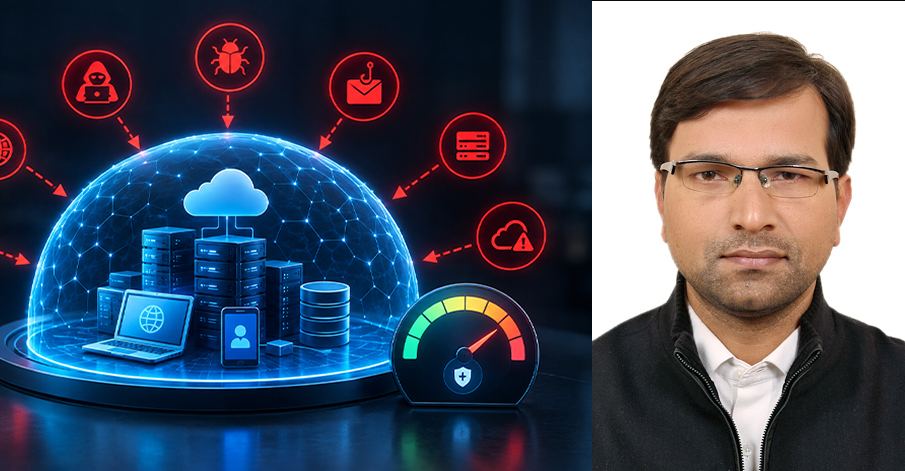
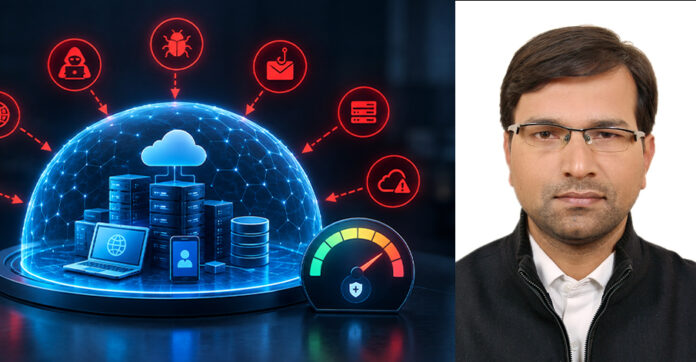

The modern threat landscape has fundamentally changed. Organisations no longer operate within the boundaries of on-premises data centres but across distributed ecosystems comprising multi-cloud environments, APIs, SaaS platforms, and containerised services. While this expansion has improved agility, it has significantly increased the external attack surface, requiring a move beyond reactive security toward strategic, risk-based exposure management.
The Asset Surface Exposure Index (ASEI) provides a framework to continuously identify, classify, assess, and prioritise internet-facing assets and associated risks. Rather than treating vulnerabilities as isolated issues, ASEI measures external exposure in the context of business criticality. Without this visibility, security teams struggle to distinguish critical risks from low-impact exposures.
Components of Attack Surface Exposure Index
A comprehensive ASEI encompasses six dimensions:
- Internet-Facing Assets — Web servers, email servers, VPN endpoints, and any publicly accessible infrastructure creating direct exposure.
- API Endpoints — Internal and external APIs, particularly where documentation is outdated or authentication misconfigured.
- Cloud and SaaS Endpoints — Unmanaged storage buckets, misconfigured authentication systems, and unsanctioned SaaS applications adopted without IT oversight.
- Forgotten Infrastructure — Legacy systems and deprovisioned services that remain internet-accessible despite lacking active maintenance.
- Domain and Subdomain Sprawl — Inactive domains and subdomains that can be leveraged for phishing, credential harvesting, or domain hijacking.
Third-Party Integrations — Connected services that multiply attack surface exponentially through supply chain relationships.
Implementation of Attack Surface Exposure Index
Implementation of Attack Surface Exposure Index are as follows:
a). Discovery and Inventory – Complete visibility of all internet-facing assets through passive and active reconnaissance
b). Asset Classification and Criticality Assessment – Categorizing assets by business impact, data sensitivity, and operational importance
c). Vulnerability and Misconfiguration Assessment – Evaluating technical security posture across multiple dimensions
d). Exposure Metrics and Scoring – Quantifying risk into actionable metrics and an overall index score
e). Continuous Monitoring and Remediation Tracking – Maintaining visibility and preventing regression through ongoing activities
How ASEI Supports ASM Prioritisation and External Risk Reduction
Asset Security Management has historically focused on discovery — necessary, but insufficient. ASEI transforms ASM from a discovery exercise into a prioritisation framework that drives resource allocation and executive decision-making across three critical areas.
- From Reactive to Strategic Allocation — ASEI creates a prioritisation framework based on asset criticality, vulnerability severity, exploitability, and business impact. Without it, security teams respond to vulnerabilities in no particular order, producing organisational chaos rather than coordinated risk reduction.
- Classification of Risk Exposure — The framework categorises exposure into Critical, High, Medium, and Low risk levels, ensuring remediation aligns with organisational priorities and risk tolerance rather than team convenience.
Optimal Resource Utilisation — Rather than each team independently working through their vulnerability backlog, ASEI aligns effort around shared critical exposures. Development focuses on application vulnerabilities; infrastructure addresses configuration issues — coordinated, not competing.
Conclusion
“If you cannot measure it, you cannot manage it.” With AI and automation accelerating the discovery of new vulnerabilities, and cybersecurity resources remaining finite, organisations cannot remediate everything simultaneously.
ASEI provides the structured framework to measure, classify, and prioritise external exposures by risk severity and business impact — enabling organisations to focus where it matters most, reduce attack surface, and maintain a stronger security posture with minimal operational effort.