


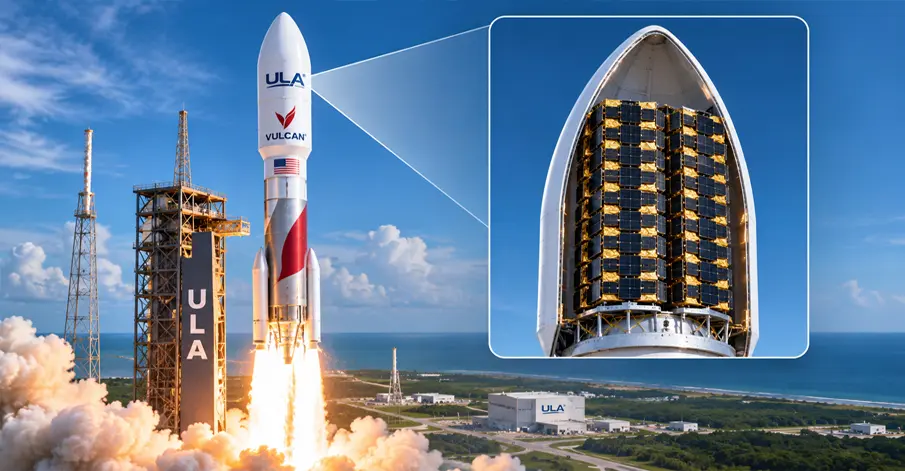
A United Launch Alliance Vulcan rocket failed approximately ten minutes after lifting off from Cape Canaveral Space Force Station, destroying 40 satellites intended for Amazon’s Leo broadband constellation. The incident was Vulcan’s first mission failure and ended ULA’s company-level record of successful missions since its creation in 2006.
ULA confirmed that the vehicle experienced an anomaly and failed to place the payload into orbit. The cause was not immediately known. The failure appeared to occur after the rocket’s second stage, carrying the satellites, separated from the first-stage booster. Blue Origin, which supplies Vulcan’s BE-4 engines, is participating in the investigation, although there was no confirmation that the engines contributed to the anomaly.
The investigation is expected to keep Vulcan from flying while engineers examine telemetry and hardware performance. The rocket had already encountered an extended nine-month gap between missions while separate questions involving its solid-rocket boosters and core engines were examined. The US Department of Defense had not cleared it to resume national-security launches before the Amazon mission.
Amazon described the flight as an inaugural mission carrying inherent launch risk and said it continued to regard ULA as a long-term partner. The failure nevertheless removes 40 satellites from a constellation that is already operating against a deployment timetable.
Since 2025, Amazon has placed 398 Leo satellites into orbit across 14 launches. That represents approximately 12% of the 3,236 satellites required for global coverage. Amazon has planned to begin an initial internet service during 2026 but depends on several external launch providers to build the network.
The company’s position contrasts with SpaceX, which operates both the Starlink satellite service and the Falcon launch system. SpaceX has deployed more than 11,000 satellites, giving it greater control over launch scheduling and replacement missions. Amazon’s other launch partners have also faced disruptions, including a Blue Origin New Glenn launchpad explosion in May. The Vulcan loss therefore compounds capacity constraints across the commercial launch market while Amazon works to meet regulatory deployment obligations and service targets.