

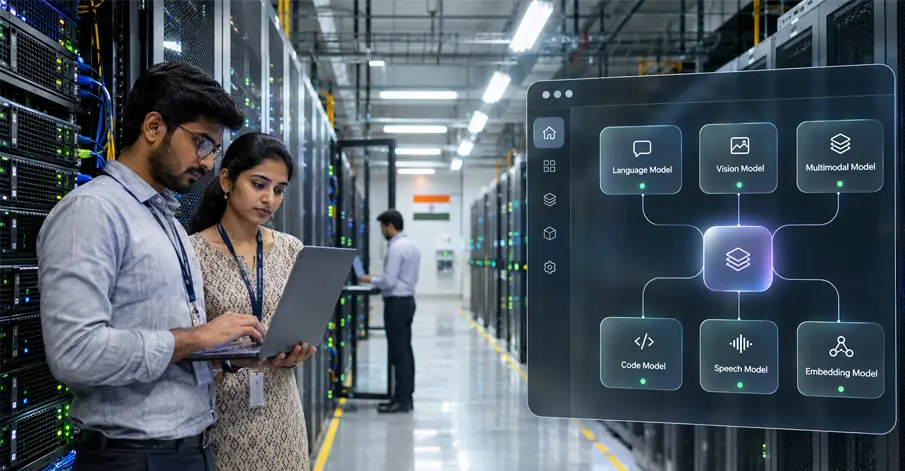
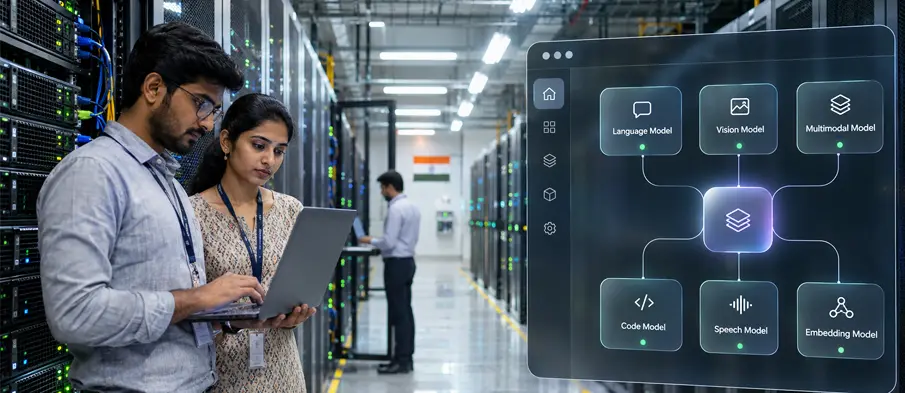
Sarvam AI has opened its Token Factory inference platform for general use, giving developers and enterprises access to its own artificial intelligence models and selected open-weight models running on GPU infrastructure in India.
The company announced the launch on 16 November. Its initial catalogue includes Sarvam 105B alongside models from the GLM, DeepSeek, Kimi and Gemma families. Customers can access the models through an OpenAI-compatible application programming interface, with Sarvam operating the underlying model-serving infrastructure.
The service offers both serverless and provisioned capacity. On its product page, Sarvam says customers can use shared infrastructure for changing workloads or discuss dedicated capacity for sustained volumes. It also advertises a 99.95% uptime commitment for enterprise deployments, subject to contractual service terms.
Sarvam says inference requests are processed on its GPUs in India and are not forwarded to overseas APIs operated by the original model developers. Zero data retention is available on request; operational-log retention is addressed separately in deployment terms. The company also says requests are encrypted and workloads are isolated by account.
Pricing varies by model and endpoint. At launch, Sarvam listed introductory rates for the standard DeepSeek V4.1 Flash endpoint of ₹14 per million input tokens and ₹55 per million output tokens. A separate interactive endpoint was listed at ₹25 per million input tokens and ₹105 per million output tokens. The company positions the standard endpoint for background and batch processing and the interactive option for workloads such as coding agents.
Sarvam has also published its own performance measurements. In one test using a client in Mumbai and a 10,000-token prompt, the company said Gemma 4 31B returned its first token in a median 0.40 seconds and generated output at 308 tokens per second. These figures are company-reported test results and are not a guarantee of performance for every production workload.
The company described changes to its inference stack intended to improve reuse of prompt context across successive requests. For DeepSeek V4.1 Flash, Sarvam said its combined cache served 95.7% of prompt tokens during the measured production period from 30 October to 6 November. It reported that the additional cache layer reduced the share of prompt tokens requiring recomputation.
Sarvam says the same inference optimisation stack is also deployed on premises for certain institutions. The company’s catalogue and terms distinguish between serverless access, provisioned throughput and separately negotiated enterprise arrangements.