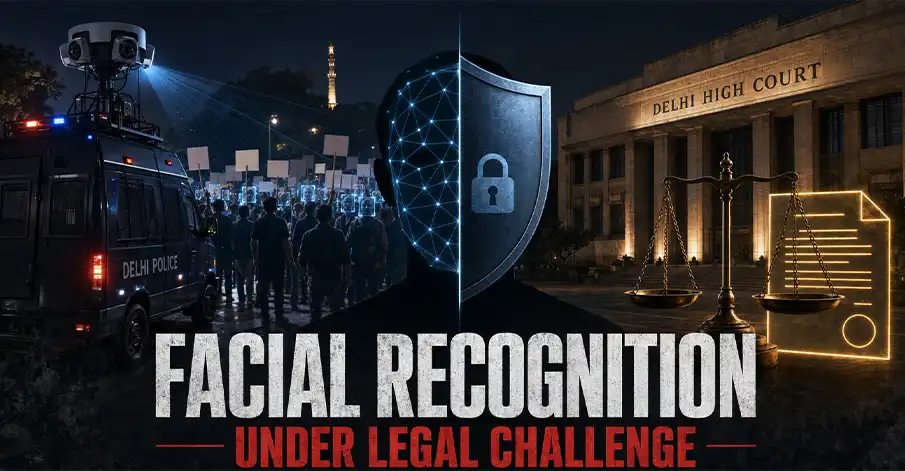
New Delhi, The use of artificial intelligence-powered surveillance technology by Delhi Police during recent student protests at Jantar Mantar has come under judicial scrutiny, raising questions over facial recognition, biometric-data collection and privacy safeguards.
Student activist Aishe Ghosh has approached the Delhi High Court seeking a declaration that indiscriminate surveillance of protesters is unconstitutional. The petition has also requested the destruction of personal and biometric data allegedly collected at the demonstration and the formulation of guidelines governing the use of surveillance technologies at public gatherings.
The technology deployed at the protest site included a mobile surveillance vehicle named “Ikshana,” equipped with cameras mounted on a telescopic mast to provide a 360-degree view. The system reportedly used AI-enabled cameras and facial-recognition software to analyse people attending the demonstration.
A computer inside the vehicle was observed displaying a detected face inside a rectangular frame, accompanied by a “face accuracy” match indicator. Police officer Raj Kumar Dahiya explained the system’s function, saying, “The computers here help us identify those who have a criminal history and it highlights them.”
“AI also helps us count the number of protesters,” he added.
Police personnel were also observed recording the Instagram handles of individuals entering the protest venue. Inspector Sunil Kumar said the checks were intended to prevent people with criminal backgrounds from entering the gathering.
Delhi Police has maintained that the technology was used for security and law-and-order purposes. In a statement posted on social-media platform X, the force said it had not “restricted anyone’s freedom through the use of facial recognition technology.”
During court proceedings, Solicitor General Tushar Mehta defended the monitoring measures as necessary and in the legitimate interest of the state. The petitioners, however, argued that the continuous surveillance was disproportionate and lacked sufficient transparency, statutory authority and procedural safeguards.
India currently does not have a dedicated law specifically governing police use of facial-recognition technology. The case could therefore provide important judicial guidance on how such systems may be deployed, what data can be collected, how long it may be retained and what accountability mechanisms must be followed.
Indian video-surveillance company CP Plus has been identified as the development partner for the Ikshana system. Information previously published by the company described it as incorporating advanced AI-powered cameras, mobile cameras and varifocal bullet cameras with adjustable lenses. The company said it supplied the surveillance hardware, while its operation and the handling of data were undertaken by the police.
The Delhi High Court’s examination of the petition could influence the future use of AI surveillance by Indian law-enforcement agencies, particularly at public demonstrations and other large gatherings