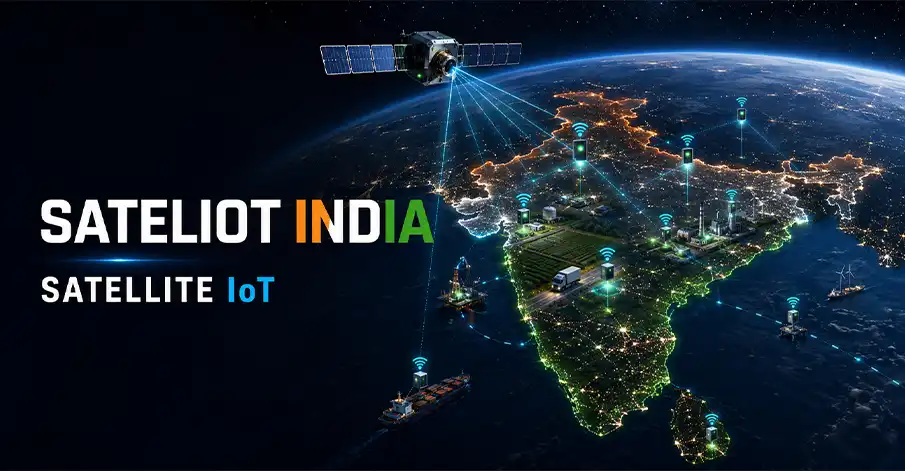
European satellite operator Sateliot has incorporated an Indian subsidiary as it prepares to enter the country’s narrowband satellite IoT market. The company specialises in Low Earth Orbit-based NB-IoT connectivity and is positioning India as a priority market for direct device-to-satellite services across agriculture, transport, mining, utilities, critical infrastructure and underserved geographies.
Sateliot’s India strategy is focused on low-bandwidth machine-to-machine communication rather than broadband internet access. Its model is distinct from satellite broadband providers because it is designed for sensors, meters, trackers and other connected devices that send small volumes of data, sometimes only a few bytes at intervals. The company says its service is based on 3GPP NB-IoT standards and operates in Mobile Satellite Service spectrum bands, placing it at the intersection of satellite communications and the emerging non-terrestrial network category.
The company has argued for a regulatory approach that recognises narrowband IoT as a distinct satellite service category. Its Asia, Africa and Middle East regulatory lead Ethan Mudavanhu has said the economics of narrowband IoT differ materially from broadband satellite services because bandwidth usage, revenue patterns and traffic loads are not comparable. Sateliot has therefore advocated spectrum pricing that reflects the amount of bandwidth used, the revenue profile of the service and its operating model.
The regulatory debate is important because India’s satellite communications framework is evolving at a time when telecom operators, broadband satellite companies and newer IoT-focused entrants are all seeking clarity on spectrum pricing, authorisation and service obligations. Sateliot has welcomed moves toward separating network infrastructure from service provision, arguing that such separation can support innovation, interoperability and competition.
India’s IoT market is expected to expand across industrial, logistics, agricultural and infrastructure use cases. Satellite IoT could support deployments where terrestrial networks are unavailable, unreliable or uneconomical, such as remote farms, mining sites, transport corridors, power distribution assets and environmental monitoring points. For enterprises, the value lies less in high-speed connectivity and more in persistent, low-cost, standards-based device reach.
Sateliot’s local incorporation marks a concrete market-entry step rather than a general expression of interest. The company is now seeking to build its India opportunity around regulatory engagement, standards-based connectivity and sector-specific IoT demand. Its entry also adds another layer to India’s satcom policy conversation: whether the market should be regulated as one broad satellite category or as multiple service classes with different technical and economic profiles.