



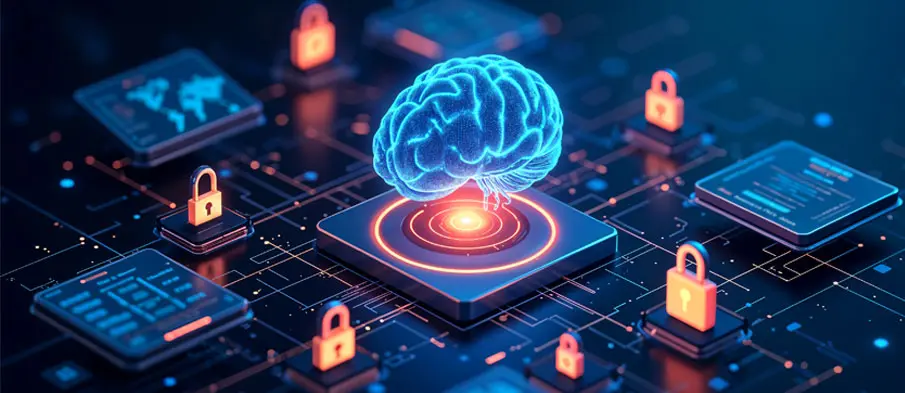
The world of cybersecurity is at the threshold of the evolutionary shift as artificial intelligence (AI), neurotechnology, and digital defense systems are merging into a new set of paradigms of security. The old methods of firewall, intrusion detection, and cryptography have always been geared towards data and network protection. Nevertheless, with the growing human-factors related connection between technology and the human body and, by extension, mind/brain, a more significant margin has emerged between biological and digital security, particularly brain- computer interface (BCI). Until recently trapped in the medical realm in terms of treating neurological conditions, neurotechnology is rapidly expanding into the mainstream human- machine interface, making brain-operated computers, neuro-prosthetics, and even thinking enhancements possible. At the same time, AI in cybersecurity has moved past simple rule-based systems towards more complex deep learning models that can be used to automatically detect anomalies, predict which attacks are based, and even automatically respond to incidents in a way that human analysts alone could not. The AI and neurotechnology might hold tremendous potential in the invention of AI like brainwave-based authentication, neuro-adaptive access control, and human-in-the-loop cybersecurity systems that can react in real-time to threats. Such convergence, however, also brings unprecedented risks into play, such as brain-jacking, cognitive hacking, and AI adversarial attacks on neural data, which are no longer the realm of science fiction. With a foot already in this new age of neuro-cybersecurity, it is important to know not only the promise behind it but also its dangers. The coming decade will prove whether this triad can make security smarter or it will raise new loopholes that pose any threat to human autonomy by principle. With digital ecosystems moving closer to being an extension of the human nervous system, the interconnection of AI, neurotechnology, and cybersecurity is no longer a technological certainty, but a strategic one.
Why the convergence matters?
Three core trends, including the development of cyber threats, the growth of human-machine interfaces, and the need to have dynamic, man-centric security platforms, spur the integration of AI, neurotechnology and cybersecurity.
First, the number and the sophistication of cyber threats have increased tremendously. Whether it is the state-sponsored attacks or the polymorphic malware, the modern day threat landscape cannot be tackled with a defensive mechanism based on rules. Artificial Intelligence (AI) remedies this gap by performing predictive analysis, anomaly detection and remediation of behaviour. Nonetheless, as much as AI is used to ensure the digital infrastructure, it is not implicitly used to improve flaws of the human aspect, which is the weakest part of security. Neurotechnology expands the aspect of defense to cover the mind on endearing the thoughts and actions that criminals have relied on cyber-based crimes, such as social engineering, phishing, and cognitive manipulation.
Second, human-machine symbiosis has been expedited due to the emergence of brain-computer interfaces (BCIs) and wearable neurotech. BCIs offer a direct interface between a neural state of being, and a digital system and in doing so they enable applications, with use in medical prosthetics to immersive virtual worlds. Although these innovations would offer unprecedented convenience and accessibility, it also generates attack vectors. Should BCIs be hacked, perpetrators might distort perception of the senses, cause false orders, or even steal cognitive information something that were only possible in science fiction but is now technically realistic. Cybersecurity cannot thus just stop at securing data, but must extend the procedure to securing the neural gateways between the mind and the machine.
Third, adaptive, context-aware security movement drives the convergence. The old authentication solutions, such as passwords, tokens, even fingerprints, are fixed, and can be circumvented. Neurotechnology makes available cognitive biometrics, e.g. patterns of brainwave activity determined by EEG, which are (naturally) more difficult to duplicate or intercept. This is when coupled with behavioral analytics applications and AI, the company is able to implement persistent dynamic authentication that adapts to the state of mind of a user in real-time. To take an example, a neuro-adaptive system would be capable of identifying stress or coercion using neural signatures and automatically activate lockdown measures.
What is more, the ability of AI to handle vast quantities of neurodata allows neuro-adaptive threat detection. AI would not just track network traffic but patterns of cognitive load and choice of security analysts and make them more capable of identifying anomalies and reacting to them. This results in the creation of human-in-the-loop defense systems, in which AI will enhance the human mind, as opposed to usurping it. At the macro level, certain industries like security, healthcare and finance facilities are examining this convergence in their quest towards the mission-critical resilience. The AI-neurotech hybrids are being tested in the military research labs to improve the decision-making process of a soldier during the cyber psychological warfare. The vision of hospitals is the safe AI-controlled BCIs that cannot be hacked. Behavioural-biometric authentication is being tested by banks with high value transactions. Finally, the convergence is reactive-proactive. Nevertheless, this symbiosis is not very old yet, and, unless suitable ethical, regulatory, and technical safeguards are in place, this kind of symbiosis will initiate an arms race between neuro-enhanced defense and neuro- targeted attacks.
Emerging Risks: When the Mind Becomes the Attack Surface
Although AI and neurotechnology convergence have the potential to provide more robust, dynamic cybersecurity, it also brings forth previously unseen risks, which stretch beyond the scope of a digital infrastructure. Among the most distressing hazards is brainjacking, under which malignant players breach brain-computer interface (BCI) vulnerabilities to control neural action. These attacks may cause false orders, change the perception of senses and even install fake memories, quite successfully interfering with the freedom of an individual.
The other emerging menace is cognitive hacking in which the enemies use neural information to manipulate decision-making and action. To illustrate, with the help of artificial intelligence and neurodata to detect unconscious biases and emotional triggers, disinformation campaigns might be personalized so as to be much more effective than regular phishing, because the attacker would know how to appeal to the greater part of a target to make them buy into the disinformation.
There are further threats to AI attacks adversarial. The attackers can present well-formulated neural signal patterns to the AIs determining who is human and who is not by unlocking their minds and identifying cognitive mind states to evade human neuro-biometric protection. Likewise, neural data exfiltration, i.e. theft of EEG based or fMRI based information, may reveal intimate mental profiles, such as preferences, fears, and even clinical status. These risks emphasize the idea that the future cybersecurity would need to protect not only networks and data but also the integrity of human cognition itself.
Conclusion:
The intersection of AI, neurotechnology and cybersecurity is bringing significant opportunities to improve digital defense services with cognitive biometrics, adaptive authentication and human-in-the-loop systems that never allow the attack to pass. However, it opens up the mind to a new surface of attack. The future of safe human-machine connections will hence be characterized by a balance between innovation, ethical considerations, regulation, and well- established neurosecurity models.




, neurotechnology, and digital....)