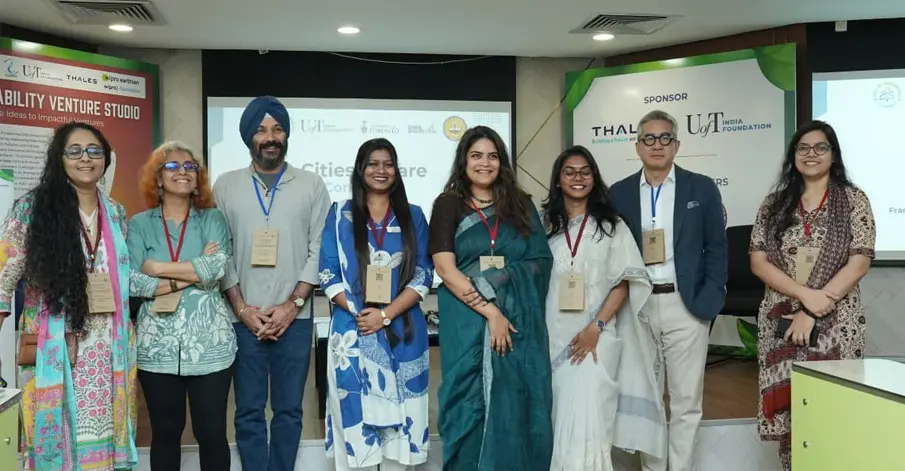
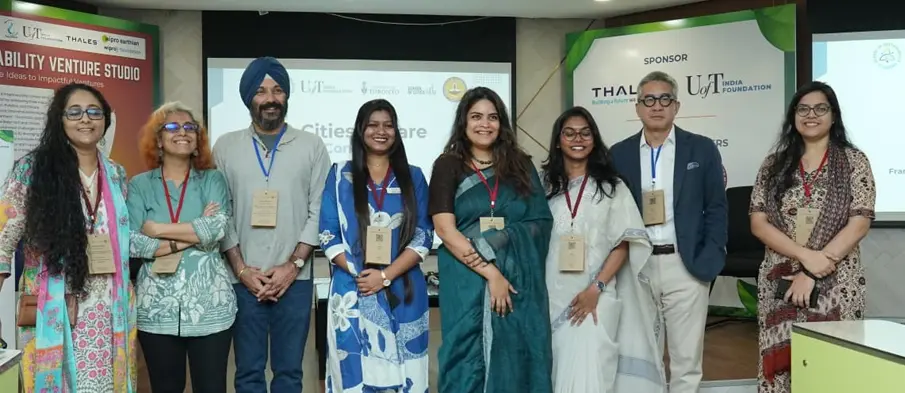
National — The University of Toronto India Foundation (UTIF) in collaboration with IIT Madras’ School of Sustainability and University of Toronto’s School of Cities today inaugurated the Cities of Care Conference at the IIT Madras Research Park, bringing together leading global universities, research institutions, policymakers and practitioners to advance climate action and rethink sustainable urban development for Indian cities.
India must move from climate ambition to climate delivery particularly in energy transition, waste management and urban resilience if it is to meet its 2030 and 2070 climate goals, according to Sustainable India 2025, a new country report released by global sustainability platform REVOLVE.
The report notes that India’s energy transition has entered a decisive phase. While renewable capacity has expanded rapidly, the next challenge lies in decarbonising industry, improving energy efficiency and scaling decentralised clean energy solutions. Rising pressure on Indian industries to “go green” risks becoming performative unless supported by practical compliance pathways, affordable finance and stronger monitoring mechanisms.
Cities of Care convened 90+ global researchers, policymakers, practitioners, and funders to explore climate action through a Water–Food–Waste systems lens. It featured plenaries, three thematic research sessions, 15 research presentations, and a cross-sector panel connecting global and Indian voices on urban complexity across water, food, and waste systems.
As part of the conference, UTIF, in collaboration with sustainability-focused media platform REVOLVE, released the Sustainable India 2025 country report, a comprehensive overview of India’s sustainability and climate action developments from across cities, states and sectors.Highlighting the importance of cross-sector collaboration, Prof. Indumathi M Nambi, Professor in Civil Engineering Department & School of Sustainability, IIT Madras said- The lab-to-market journey is long and challenging. We need platforms like this educating researchers to work on real-world problems, enabling governments to create supportive policies and programs, and bringing businesses and academia together to identify challenges and fund applied research and technology development. It is equally important to educate investors to value impact metrics alongside financial returns.
About the Sustainable India Report
The 2025 edition of REVOLVE’s Sustainable India report brings together on-the-ground sustainability updates from across the country, documenting how climate action is being shaped at national, state and city levels. The report features in-depth stories, expert interviews, photo essays and curated key facts, offering insights into the projects, ideas and people driving India’s sustainability journey.
The report also reflects the broader influence of India’s eight national climate missions, capturing developments across climate resilience, energy transition, ecosystems, water systems, sustainable mobility and inclusive development. By combining narrative storytelling with evidence-led insights, Sustainable India 2025 serves as a knowledge resource for policymakers, researchers, practitioners and institutions working on climate-resilient urban development.
The report features a foreword by Gauravi Lobo, Country Head, UTIF, titled “No City Stands Alone: Reimagining Collaborative Urbanism,” which underscores the importance of cross-sectoral and cross-border collaboration in addressing complex urban and climate challenges.
The conference features speakers from leading Indian and global institutions, including Prof. Joseph Wong, Vice President (International), University of Toronto; Dr. Supriya Sahu, IAS, Secretary, Department of Environment and Climate Change, Government of Tamil Nadu; Prof. Isha Ray, Energy and Resource Group, UC Berkley; Mr. Takayuki Hagiwara, FAO Representative in India; and Ms. Veena Srinivasan, Executive Director, WELL Labs Mission.
Discussions across the conference focus on translating research into policy-relevant insights, strengthening collaboration between academia, government and practitioners, and advancing integrated approaches to urban challenges through the lens of Water–Food–Waste Nexus
In addition to dialogue and knowledge exchange, the conference is designed to inform future research collaboration, policy discussions and implementation pathways. Insights emerging from Cities of Care are expected to contribute to ongoing academic work, practitioner engagement and institutional partnerships aimed at strengthening climate-resilient urban development in India.
The Cities of Care Conference continues with thematic sessions, poster presentations and collaborative discussions focused on shaping actionable pathways for a sustainable and resilient urban future.