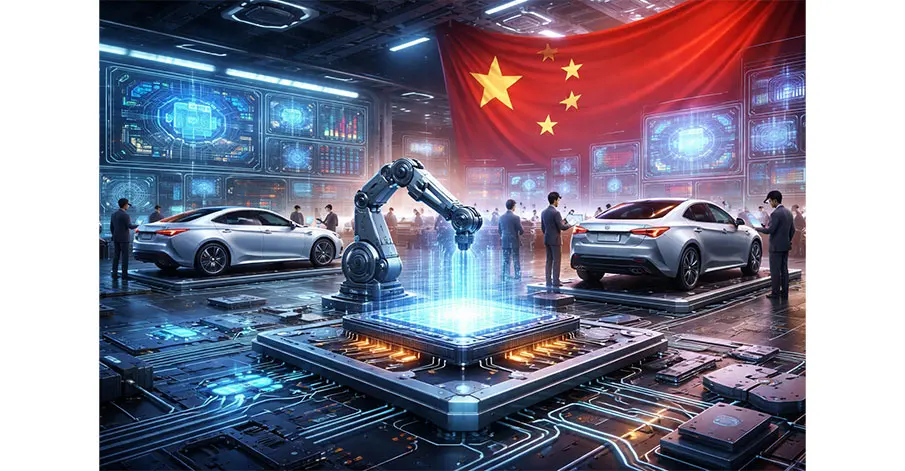
Chinese electric vehicle manufacturers are increasingly investing in semiconductor chips and artificial intelligence as competition in the industry moves beyond production scale toward technological differentiation. The shift reflects a broader transition in the EV market, where innovation in software, computing power, and intelligent systems is becoming a key competitive advantage.
Automakers are accelerating efforts to integrate core technologies such as batteries, chips, and AI into their vehicles, aiming to build more advanced and self-reliant ecosystems. This vertical integration allows companies to optimize performance, reduce dependency on external suppliers, and create more tightly connected intelligent vehicle platforms.
Several leading Chinese EV companies have already begun developing in-house chips to power autonomous driving and AI-driven features. For instance, firms like Nio have introduced proprietary chips designed to handle high-performance computing tasks required for advanced driver-assistance systems and real-time data processing, highlighting the growing importance of chip capabilities in modern vehicles.
The increasing focus on AI is also transforming automakers into technology-driven companies rather than purely manufacturing businesses. Companies are investing in areas such as autonomous driving, smart cockpits, and even robotics, positioning themselves within the broader “physical AI” ecosystem. This trend mirrors a shift where vehicles are becoming software-defined platforms powered by continuous AI updates and data-driven insights.
At the same time, geopolitical factors such as restrictions on advanced semiconductor exports are pushing Chinese companies to accelerate domestic innovation in chips and AI infrastructure. As global competition intensifies, these investments are expected to play a crucial role in determining long-term leadership in the EV and intelligent mobility sectors, where technological capability is increasingly outweighing manufacturing scale.