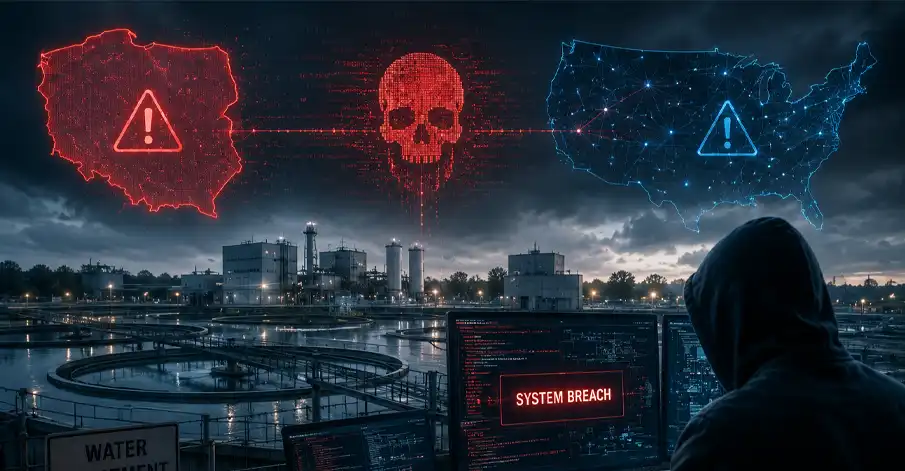
Polish authorities have warned that hackers are increasingly targeting water treatment and wastewater infrastructure, raising concerns about growing cyber threats against critical public utilities. Officials stated that several cyberattacks aimed at disrupting water systems have already been detected across Poland, with experts warning that similar vulnerabilities exist in the United States.
According to Poland’s Deputy Prime Minister and Minister of Digital Affairs Krzysztof Gawkowski, attackers — believed to be linked to Russia — have been attempting to compromise industrial control systems connected to water and sewage facilities. The attacks reportedly targeted operational technology (OT) environments responsible for managing water distribution, treatment processes, and infrastructure monitoring.
Cybersecurity researchers and government officials noted that many water utilities still rely on outdated industrial systems that were not originally designed with strong cybersecurity protections. Smaller municipalities and local utilities are considered particularly vulnerable because of limited cybersecurity budgets, aging infrastructure, and weak network segmentation between business systems and operational control networks.
Security experts have warned that the United States faces many of the same risks. In recent years, multiple American water utilities have experienced cyber incidents involving exposed internet-connected control systems, default passwords, and insecure remote access tools. Officials from the U.S. Environmental Protection Agency (EPA) and the Cybersecurity and Infrastructure Security Agency (CISA) have repeatedly warned that foreign threat groups are actively scanning and targeting critical infrastructure systems across the country.
The report follows a series of recent attacks against water facilities globally. In some previous incidents, hackers managed to alter chemical dosing systems, disable monitoring equipment, or gain unauthorized access to supervisory control and data acquisition (SCADA) systems used in utility operations. Although many attacks were detected before causing physical damage, experts warn that successful intrusions could potentially disrupt water supply or compromise public safety.
Polish authorities stated that cybersecurity monitoring around critical infrastructure has been increased, particularly after heightened geopolitical tensions in Europe. Governments and security agencies are now urging utility operators to strengthen password policies, isolate operational networks, implement multi-factor authentication, monitor industrial systems continuously, and prepare incident response plans to reduce the risk of future attacks.