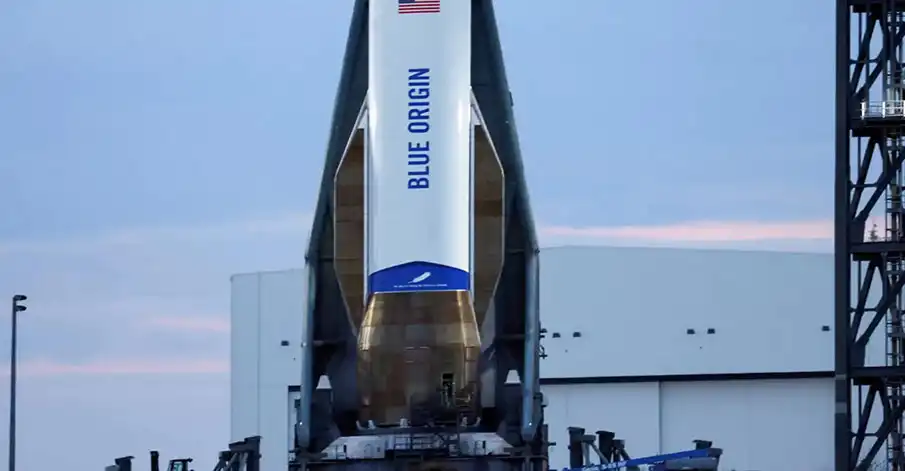
Blue Origin suffered a significant setback after its uncrewed New Glenn rocket exploded during a launchpad test in Florida, raising fresh challenges for the company’s efforts to compete more aggressively with SpaceX in the rapidly expanding heavy-lift space launch market.
The incident occurred during a hot-fire test at Cape Canaveral on May 28, when the towering New Glenn rocket ignited on the launchpad before erupting into a massive fireball moments later. Dramatic visuals from the site showed thick smoke and flames rising high above the launch complex following the explosion, drawing immediate attention across the global aerospace industry.
Blue Origin later confirmed that an “anomaly” had occurred during the test operation. The company stated that all personnel were safely accounted for and that an investigation into the incident is currently underway. The explosion marks a major hurdle for the Jeff Bezos-owned space company as it continues development of its next-generation launch systems designed for commercial, government, and deep-space missions.
The New Glenn rocket is considered central to Blue Origin’s long-term ambitions in orbital transportation and lunar exploration. The heavy-lift vehicle has been positioned as a direct competitor to SpaceX’s advanced launch systems, particularly in the race for large-scale satellite deployment, commercial space missions, and government contracts tied to future Moon exploration initiatives.
The setback may also have implications for future collaboration with NASA programs, including Artemis-related missions and broader Moon Base development plans. NASA is expected to evaluate how the incident could impact timelines connected to future lunar transportation and infrastructure strategies.
The explosion highlights the immense technical and operational challenges involved in developing heavy-lift rocket systems capable of supporting long-duration space missions and human exploration beyond Earth. Both Jeff Bezos and Elon Musk have previously acknowledged the complexity and risks associated with large rocket development, where testing failures are often viewed as part of the engineering process.
As competition intensifies within the private space industry, the incident underscores the high-stakes nature of commercial space exploration, where companies are racing to build reliable next-generation launch systems for government contracts, satellite launches, and future deep-space operations.
The explosion serves as a reminder that space innovation, heavy-lift rocket development, and lunar exploration ambitions continue to involve significant technological risks despite rapid advancements across the global aerospace sector.