New Delhi, The central government has commissioned a demonstration network based on White Rabbit precision-timing technology to distribute a secure and tamper-resistant Indian Standard Time signal across critical infrastructure.
The network was launched by Union Minister for Consumer Affairs, Food and Public Distribution Pralhad Joshi at the Regional Reference Standard Laboratory in Bengaluru. It has been developed jointly by the Department of Consumer Affairs, CSIR-National Physical Laboratory and the Indian Space Research Organisation.
The system disseminates Indian Standard Time traceable to UTC (NPLI), the country’s official national time standard maintained by CSIR-NPL. White Rabbit technology combines the Precision Time Protocol with advanced networking capabilities to provide highly accurate synchronisation across connected systems.
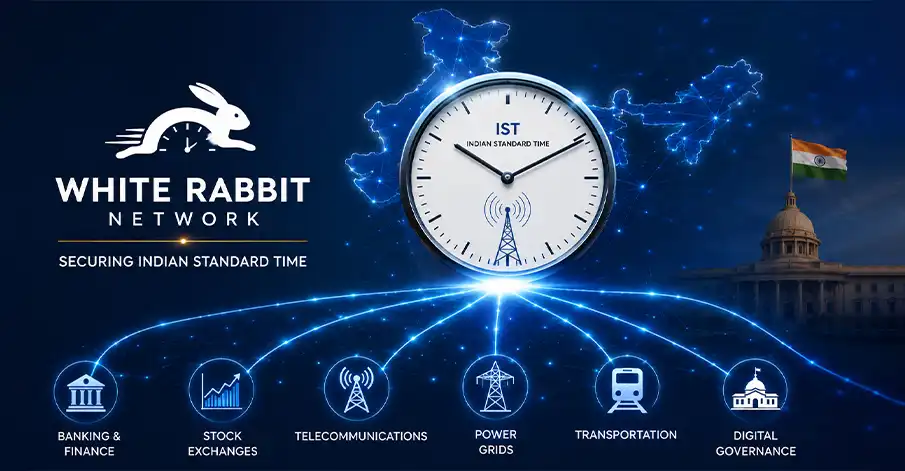
The technology is expected to support sectors where even minor timing discrepancies can disrupt operations, including banking, stock exchanges, telecommunications, power grids, transportation and digital-governance platforms. Accurate and traceable timestamps are also critical for transaction validation, cybersecurity investigations, network coordination and the operation of automated infrastructure.
The ministry, working with ISRO, the Securities and Exchange Board of India, National Stock Exchange and Bharat Sanchar Nigam Limited, has completed a verification test for secure time transmission between the Bengaluru laboratory and NSE’s facility in Chennai.
The demonstration network forms part of the government’s broader Indian Standard Time Dissemination Project under the “One Nation, One Time” initiative. The programme seeks to establish an indigenous and reliable national timing infrastructure while reducing India’s dependence on foreign timing sources, including satellite-based systems.
A secure domestic timing network could strengthen cyber resilience by making it more difficult to manipulate timestamps used by financial institutions, telecom networks and government platforms. It could also improve the reliability of power and transportation systems that depend on precisely synchronised devices and data exchanges.
The Department of Consumer Affairs said the initiative, alongside reforms to India’s legal metrology framework, is expected to improve consumer confidence, support fair trade and ease business operations. The project also advances the government’s technological self-reliance agenda by positioning India among countries capable of distributing sovereign precision-time signals to critical national systems.