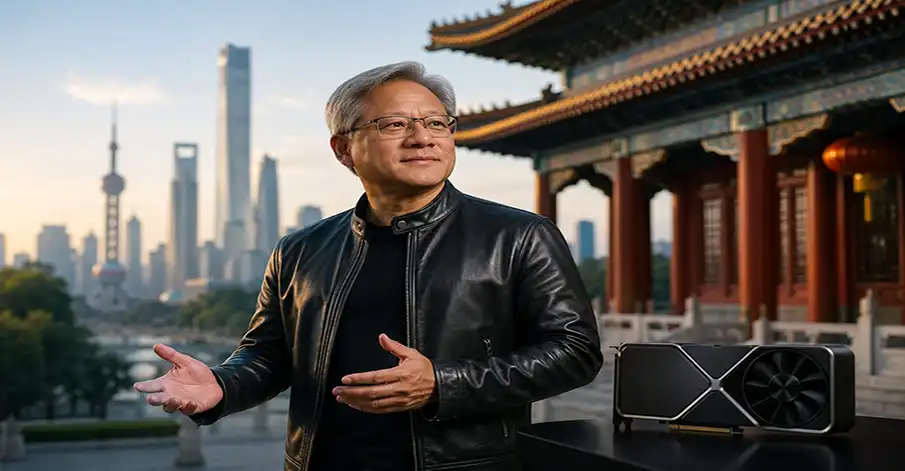
Jensen Huang, the chief executive of Nvidia, is set to join the advisory board of Tsinghua University School of Economics and Management, according to reports citing individuals familiar with the matter. The development further highlights the growing relationship between global technology leaders and leading academic institutions in China amid intensifying international focus on artificial intelligence and advanced semiconductor technologies.
The report stated that Huang accepted an invitation from the School of Economics and Management at Tsinghua University, one of China’s most prominent higher education institutions known for educating senior political and business leaders. The advisory board of the institution already includes several influential international business figures, with Tim Cook currently serving as chair.
Huang’s appointment comes shortly after his recent visit to China alongside Donald Trump during the U.S. president’s trip to the country earlier this month. The visit drew significant attention due to ongoing global discussions surrounding semiconductor supply chains, artificial intelligence leadership, and technology cooperation between the United States and China.
Nvidia has remained one of the most influential companies in the global AI industry, driven by soaring demand for its advanced graphics processing units and AI-focused computing systems. Huang’s growing international engagement reflects the increasing importance of academic, governmental, and industry collaboration in shaping the future of artificial intelligence research and technological development.
Tsinghua University is widely regarded as one of China’s top institutions for engineering, economics, and technology-related education. Its advisory board includes executives and policymakers from across the global business landscape, serving as a platform for discussions on innovation, economic strategy, and emerging technologies.
The reported move also comes at a time when major technology firms are strengthening ties with universities to support AI research, talent development, and long-term innovation initiatives. Industry leaders increasingly view academic partnerships as essential for maintaining competitiveness in rapidly evolving fields such as semiconductors, machine learning, and advanced computing.
Huang’s expected addition to the board underscores the expanding global influence of AI industry executives and reflects the broader convergence of technology leadership, higher education, and international strategic cooperation in the rapidly evolving artificial intelligence era.