


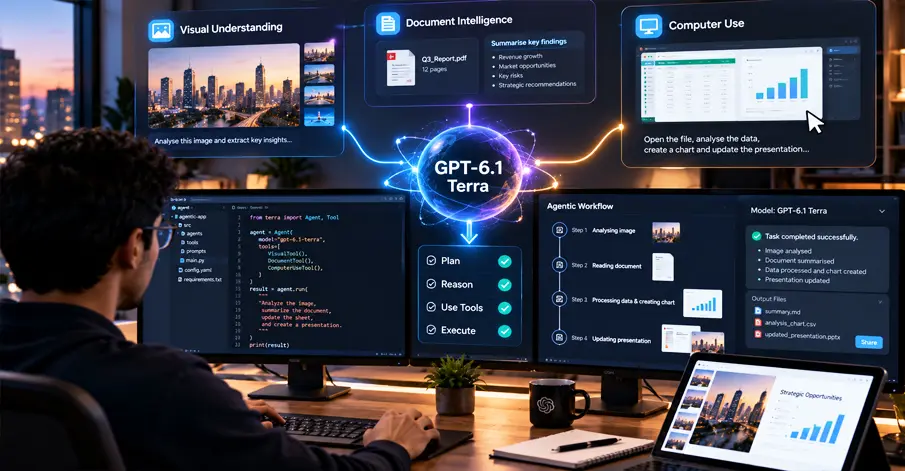
OpenAI has released GPT-6.1 Terra, a new model designed for visual understanding, computer interaction, writing and agentic work. The model is available to Plus, Pro, Enterprise and Edu customers through ChatGPT Work and Codex, as well as through the API under the identifier gpt-6.1-terra.
Standard API pricing is set at $1 per million input tokens, $0.05 per million cached input tokens and $5 per million output tokens. OpenAI says these rates are 50% below the standard pricing of GPT-5.6 Terra and GPT-6.1 Sol, lowering the direct inference cost for organisations deploying the model in production workflows.
The model supports a context window of 1.05 million tokens and has a knowledge cutoff of June 1, 2026. The large context capacity is intended for tasks involving extensive codebases, document collections and multi-stage agent workflows where the model must maintain access to a substantial working set.
On OpenAI’s Agents’ Last Exam benchmark at medium reasoning effort, the company says Terra scored 15 percentage points above GPT-5.6 Terra at about one-third of the cost. It also reportedly matched GPT-6 Astra at one-tenth of the token price and completed tasks more than three times faster on average than Astra and GPT-6.1 Sol. These results are company-generated and have not yet been independently reproduced.
On Terminal-Bench 4.0 at maximum reasoning effort, OpenAI reports a 50.3% task-completion rate, compared with a published 21.5% score for GPT-5.6 Terra. The company also reported reductions in errors on an internal set of deliberately misleading prompts.
OpenAI classifies the model at the “Critical” cybersecurity threshold under its Preparedness Framework. That designation reflects advanced capability rather than a disclosed incident, and places additional importance on access controls, monitoring and deployment safeguards.
The release gives Indian software companies, IT-service providers, GCCs and enterprise development teams a lower-priced model aimed at coding, computer use and document-intensive automation. Actual production performance will depend on latency, tool reliability, security controls and application-specific evaluation beyond the company’s benchmark results.



