 For over a decade, the gospel of digital publishing was simple: rank for more keywords, get more traffic. New data suggests that gospel is broken — and has been for years.
Imagine pouring ten times more fuel into an engine, only to find it runs barely twice as fast. That is precisely the paradox now confronting digital publishers, according to a sweeping long-term study published this month by XSquareSEO.
The firm tracked 43 major U.S. digital publishers across 14 years — from January 2012 to May 2026 — measuring one of the most fundamental relationships in online media: the link between showing up in search results and actually receiving visitors. What they found should give every publisher, marketer, and media strategist pause.
Between 2015 and 2026, the combined organic keyword rankings of those 43 publishers surged by 530%. Their combined organic traffic, however, grew by just 68%. The gap between the two numbers tells a story the industry has largely been reluctant to confront.
The Efficiency Cliff — and It Happened in 2016
The study introduces a sharp analytical lens it calls “traffic per keyword efficiency” — simply, how much traffic each ranking actually delivers. Plot that metric over time and a dramatic picture emerges: a cliff edge, appearing around 2016, after which the ratio between rankings and traffic collapsed and never recovered.
Before 2016, earning a new keyword ranking broadly meant earning new visitors. After 2016, publishers kept stacking rankings at speed — but each new one delivered diminishing returns. The more they ranked, the less each ranking was worth.
This finding carries a particular sting for the current moment. Much of the recent industry conversation about falling organic traffic has blamed AI Overviews and generative search systems — the wave of technology that began reshaping Google’s results pages from 2023 onwards. The XSquareSEO data complicates that narrative significantly. The structural break predates the AI era by nearly seven years. What AI may be doing, the data implies, is not creating a new problem but accelerating a very old one.
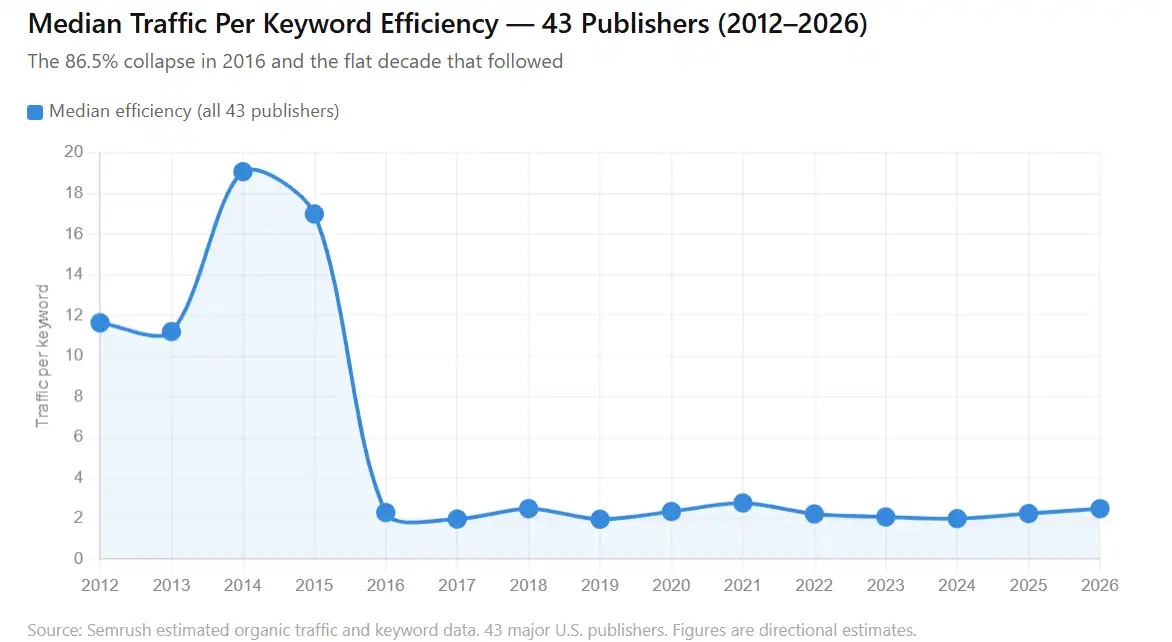
From 2016 onward, efficiency never recovered. For ten consecutive years the median has oscillated between 1.96 and 2.76. The pre-2016 era appears to be structurally gone.
Almost Nobody Escaped
The findings are striking in their consistency. Of the 43 publishers studied, 42 showed stronger keyword growth than traffic growth across the study period. This is not a tale of winners and losers — it is a near-universal pattern affecting some of the most established names in online media.
In multiple cases, publishers dramatically expanded their keyword footprint — appearing in hundreds of thousands more search results — while experiencing minimal traffic gains, or in some cases, outright traffic declines. Fifteen publishers, the study notes, lost absolute traffic despite ranking for more keywords than ever before.
The implication is unsettling: scaling keyword rankings, the dominant strategy of the SEO era, no longer guarantees proportional returns. The treadmill is moving faster, but it is taking people further from the destination.
What Changed — and Why It Matters
The study does not definitively answer why 2016 marked the turning point, but the period aligns with several shifts in how Google structured its search results: the expansion of featured snippets, the growth of “zero-click” search results where users receive answers without visiting a site, and increasing real estate given to ads, maps, and Google’s own properties above organic listings.
In short, ranking became easier to achieve — but the payoff for ranking shrank as Google’s results pages became more crowded and more self-contained.
What this means practically is a fundamental reframing of how SEO success should be measured. The study suggests that the industry is moving — whether it acknowledges it or not — away from a world where visibility equals traffic, toward one where publishers gain exposure across many more queries but harvest far less from each. Brand recognition, direct audience relationships, email lists, and loyal readership may matter more going forward than any keyword count.
The Broader Lesson
For publishers, brands, and anyone who has built a strategy around organic search, the XSquareSEO findings serve as a 14-year audit of the assumptions underpinning that strategy.
Ranking more is not the same as growing. Visibility is not the same as reach. And the algorithm that once rewarded content production at scale is now distributing the spoils so thinly that the returns barely justify the effort.
The treadmill is not broken. It still runs. It is just moving faster while delivering less.
The full study, including publisher-level data and methodology, is available at xsquareseo.com.
Editorial Team