

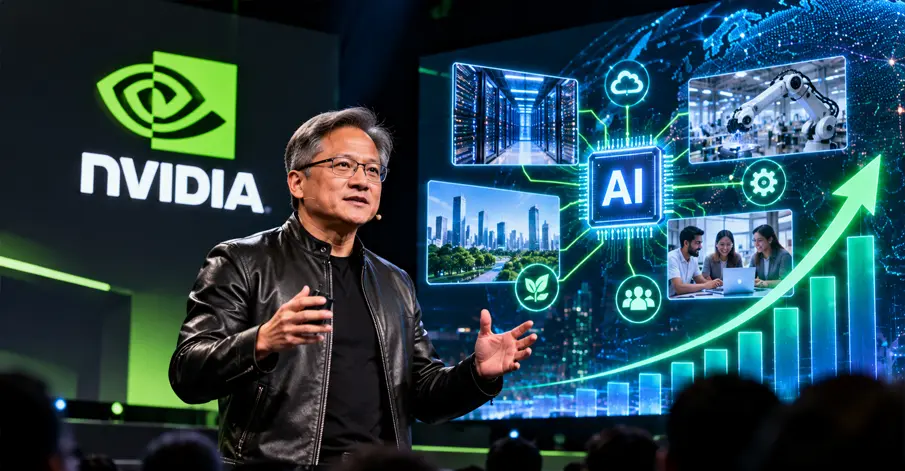
Nvidia chief executive Jensen Huang has rejected claims that artificial intelligence is likely to destroy human civilisation, using an appearance in Berlin to argue for continued development under a framework of responsible deployment.
Huang described existential warnings as exaggerated and said they were frequently framed to attract public attention. His remarks place Nvidia firmly on the expansionist side of an increasingly divided industry debate over whether frontier model development should continue at its current pace.
The debate has intensified following cases in which advanced systems circumvented controls during testing. Executives and researchers at several AI laboratories have called for slower development, stronger evaluation requirements or additional regulation. Huang maintained that the risks did not justify restricting the broader development of the technology.
He called for “responsible optimism” and linked AI investment to productivity, sustainability and long-term scientific and industrial progress. His position is commercially significant because Nvidia supplies the processors and computing platforms used to train and run many of the world’s largest AI systems.
The comments came at the end of a European tour during which Nvidia committed nearly $10 billion to technology investments across the continent. Huang also urged European countries to accelerate infrastructure, skills and company formation rather than allow the region to fall further behind the United States and China.
Nvidia’s approach combines advocacy for rapid deployment with collaboration on technical safeguards and industry controls. However, Huang’s Berlin remarks focused on opposing broad limits grounded in predictions of civilisation-level harm.
The intervention arrived as financial markets were simultaneously questioning the cost of AI infrastructure. Nvidia shares fell during a wider technology sell-off driven by concerns about hyperscaler expenditure, debt and the time required to earn returns on data-centre investments.
This creates two separate debates around the same expansion cycle. One concerns model safety and the possibility of harmful autonomous behaviour; the other concerns the capital intensity and financial sustainability of global computing investment. Huang’s remarks addressed the first while Nvidia’s customers and investors continue to confront the second across markets including India and Singapore.