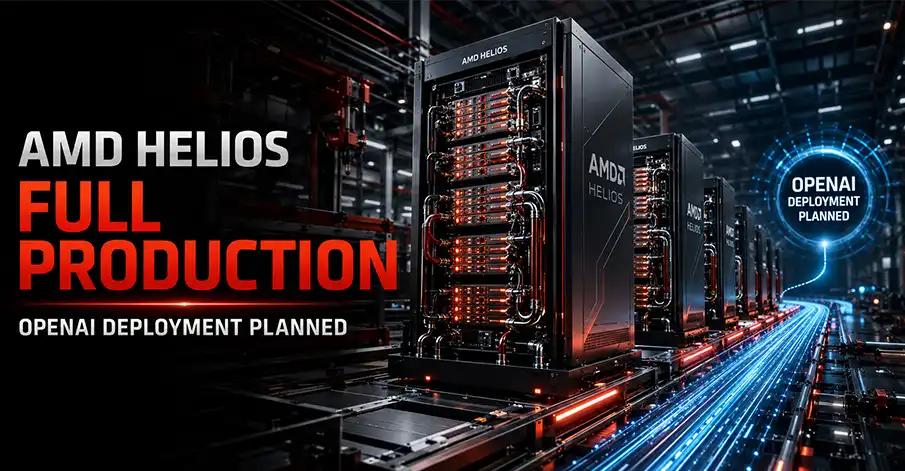
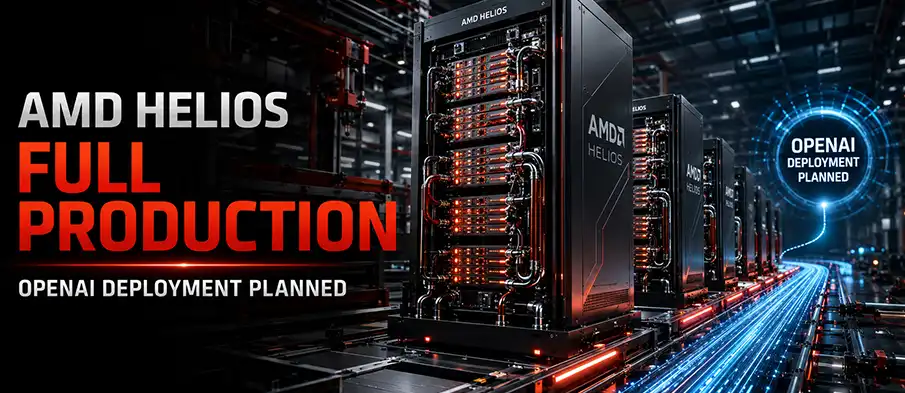
Advanced Micro Devices CEO Lisa Su said the company’s second-generation Helios AI servers are in full production and will begin shipping in the coming months, with shipments slated to start at the end of the third quarter. The Helios racks will contain AMD’s MI455X AI accelerator and its Venice central processor, both manufactured by Taiwan Semiconductor Manufacturing Co. During Su’s keynote at an event in San Francisco, OpenAI Vice President of Compute Strategy Sachin Katti said the company expects to deploy Helios at massive scale toward the end of 2026 and accelerate deployment through 2027.
AMD is positioning Helios as part of its effort to capture share in the fast-growing data-centre AI chip market, particularly in inference computing, where demand is rising as users query AI systems at scale. Su said customer demand for Helios is extremely strong and argued that AMD is making another major leap in scale-up compute. She also said AMD estimates the total computing market could reach $2 trillion by 2030, including $1.4 trillion from AI accelerator chips and $220 billion from central processing units.
The announcement extends AMD’s broader commercial push into AI infrastructure. In October, AMD announced a multiyear agreement with OpenAI expected to generate tens of billions of dollars in annual revenue, while giving OpenAI the option to buy up to about 10% of AMD. AMD also announced plans to sell up to two gigawatts of Instinct MI450 chips to Anthropic beginning in the first half of 2027, alongside an investment of up to $5 billion in the Claude maker. At the San Francisco event, Anthropic co-founder Tom Brown said Claude had been able to set up AMD’s AI servers on its own over a weekend, highlighting the developer and automation angle of the partnership.
The hardware roadmap matters for buyers planning AI compute availability, supplier diversity and workload economics. Indian data-centre operators, cloud providers, GCCs and large enterprises are still navigating limited access to high-end accelerators, long deployment timelines and fast-changing model requirements. A credible alternative to Nvidia’s dominant stack can affect pricing, procurement leverage, and the architecture choices available to companies building inference-heavy AI applications. AMD also displayed Helios amid cloud providers using AMD hardware, indicating that the route to market may include both direct enterprise infrastructure and AI compute consumed through cloud partners.