


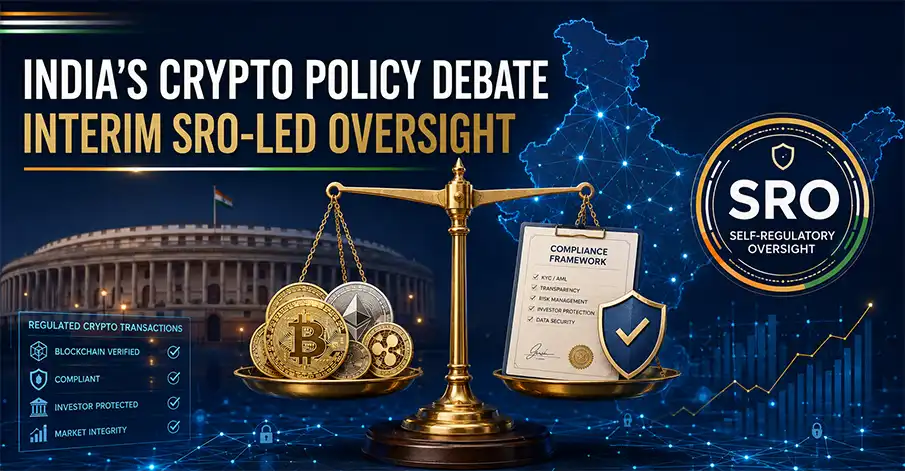
India’s virtual digital asset policy debate has moved into a fresh phase after the Parliamentary Standing Committee on Finance recommended an interim regulatory mechanism for cryptocurrencies and other VDAs through recognised self-regulatory organisations operating under the supervision of a designated statutory regulator. The recommendation forms part of the committee’s examination of the proposed Securities Markets Code, 2025, which seeks to consolidate and modernise securities-market law while leaving open a key question: how to treat digital assets that do not neatly meet the legal definition of securities or derivatives.
The recommendation is significant because India’s crypto sector has so far operated under a compliance-heavy but structurally incomplete regime. Crypto transactions are taxed, platforms face anti-money-laundering obligations, and reporting requirements have expanded, but the market still lacks a dedicated operating framework covering licensing, custody standards, product classification, investor protection, market conduct, and dispute resolution. The committee’s suggested SRO route would not amount to full legal recognition of all VDAs as securities. Instead, it proposes a temporary governance layer while a comprehensive digital-asset law is developed.
The committee also appears to recognise the varied nature of VDAs. Tokenised securities, payment-linked assets, stable-value instruments, utility tokens and crypto-native assets may require different regulatory treatment. A single classification could either overreach into assets that do not function like securities or under-regulate products that have investment-like characteristics. That distinction matters for exchanges, custodians, wallet operators, fintech firms and institutional investors looking for a clearer compliance map.
Industry executives have welcomed the prospect of moving beyond a policy framework dominated by taxation and enforcement. The central question now is how an SRO would be constituted, what powers it would have, and which regulator would supervise different asset classes. A narrow SRO role could cover audits, member codes, grievance redressal, advertising standards and baseline operational checks. More consequential powers, including licensing, enforcement, capital adequacy and product approval, would likely remain with statutory regulators.
The proposal also sits alongside global shifts in digital-asset regulation. Markets such as the European Union, Singapore, Hong Kong and the UAE have created more formal regimes for crypto service providers, while the United States continues to refine the division between securities and commodities oversight. India’s approach has remained cautious, shaped by consumer-protection concerns, capital-control considerations, cyber risk and the difficulty of supervising offshore actors. The committee’s recommendation does not settle those questions, but it gives policymakers a concrete pathway for interim supervision without waiting for a complete statute.