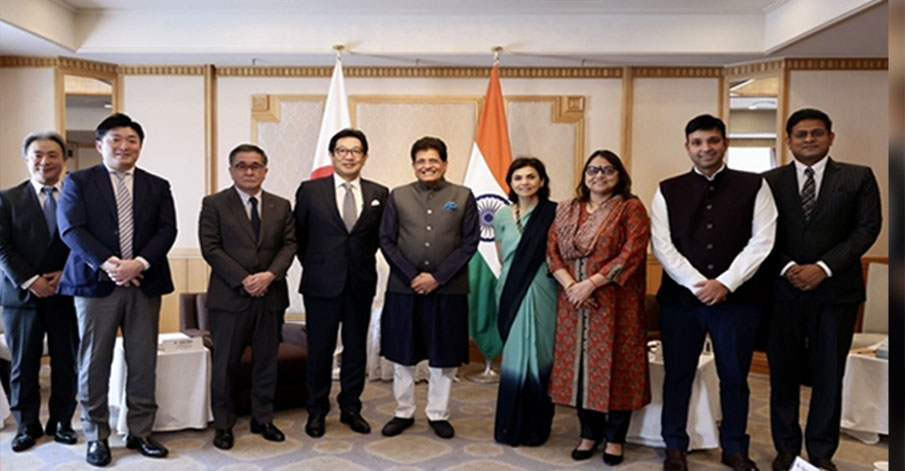
The Indian government is developing a framework that could exempt high-technology manufacturers from mandatory Bureau of Indian Standards certification for selected equipment and components required to establish production facilities in the country. Commerce and Industry Minister Piyush Goyal disclosed the work during meetings with Japanese semiconductor and artificial-intelligence companies in Tokyo on August 25.
The proposed framework could allow exemptions at the company, industry, product or individual-project level. Its stated objective is to prevent certification procedures from delaying the import of specialised machinery, components and services needed during the construction and commissioning of high-technology factories. The government has not yet published the framework, identified the products that would qualify or announced an implementation date.
Goyal’s discussions formed part of a four-day Japan visit backed by a delegation of more than 200 Indian business representatives. The programme spans semiconductors, electronics, artificial intelligence, clean energy, steel, automotive manufacturing, financial services, healthcare and startups. Meetings have included Japanese government officials, financial institutions, industry groups and corporate executives.
Data-centre investment was another major component of the discussions. Goyal presented India as a potential destination for Japanese participation in digital infrastructure and said the country had received investment commitments worth about $200 billion from large global hyperscalers. The minister also cited projections placing India’s semiconductor demand at as much as $150 billion by 2032.
The engagement is being organised around four pillars: expanded trade, deeper technology cooperation, increased investment and stronger movement between the two economies. India is seeking Japanese capital and industrial expertise across semiconductor production, electronic components, artificial-intelligence infrastructure and advanced manufacturing. The government is also discussing supporting infrastructure at manufacturing locations, including Dholera, where semiconductor and electronics investments are being developed.
The BIS proposal addresses a recurring operational issue for technology manufacturers whose production tools may be built in small volumes, configured for a specific factory or covered by established international standards but not immediately certified under Indian requirements. Any exemption mechanism would still need to define eligibility, oversight and the treatment of safety- or quality-sensitive equipment.
The initiative remains a policy under development rather than an enacted regulatory change. Its commercial effect will depend on the final scope, duration and administrative process, including whether exemptions can be approved at project scale instead of through separate applications for each imported product.
The latest discussions follow India and Japan’s established cooperation in infrastructure and industrial manufacturing while moving semiconductor supply chains, AI systems and data centres closer to the centre of the bilateral investment agenda. The government has confirmed the delegation’s high-technology focus, while the minister’s Tokyo remarks set out the proposed certification options and data-centre discussions.