


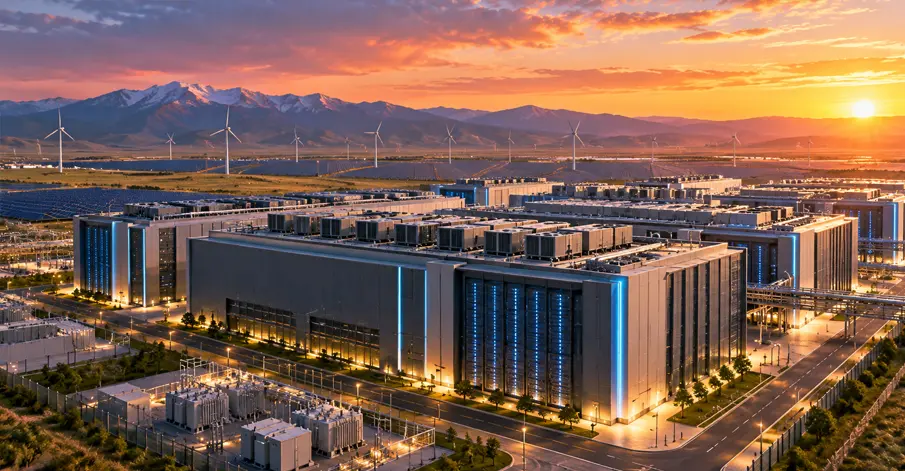
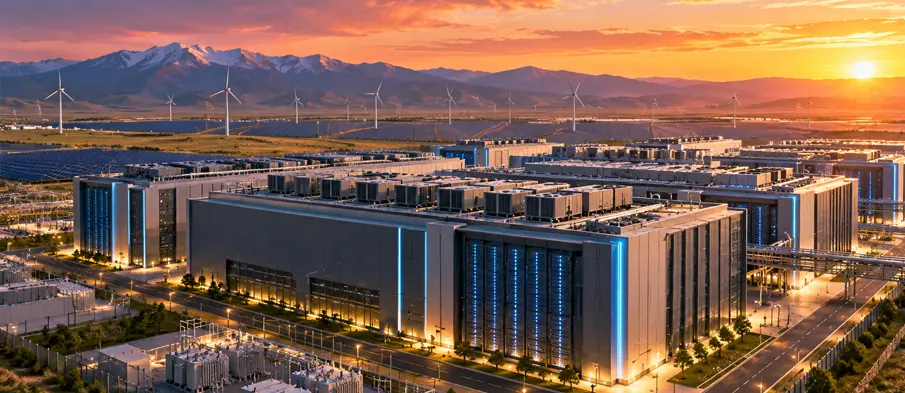
Envision has commissioned the Galaxy Campus, a gigawatt-scale artificial intelligence data-centre development in Ulanqab, Inner Mongolia, as the first flagship project under its Mission Gobi programme. The facility combines computing infrastructure, renewable generation, transmission, storage and intelligent energy controls within a single operating architecture.
The campus includes a 120,000-square-metre AI supercomputing facility designed to deliver one million PFLOPS of computing capacity. At full build-out, the development is expected to support as many as one million AI accelerators and could scale beyond 2 GW of capacity.
Mission Gobi targets the development of 5 GW of green AI data-centre capacity in desert and arid regions worldwide by 2030. Envision founder and chief executive Lei Zhang first presented the programme at VivaTech in Paris in June 2026. The company is entering AI infrastructure from its established position in renewable-energy systems, enabling it to design generation, grid connectivity, battery storage and computing capacity as an integrated system.
The Galaxy Campus has been designed around the growing power and cooling requirements of large AI clusters. Its energy system combines renewable generation with dedicated transmission infrastructure, large-scale storage and software-based controls intended to deliver a stable electricity supply. Envision is treating energy availability as an integral part of the computing architecture rather than as a conventional utility connection added after the data-centre design is completed.
Ulanqab is approximately 300 kilometres west of Beijing and has an annual average temperature of about 4.3 degrees Celsius. The cooler climate can support natural or “free” cooling for parts of the year, reducing the electricity required for mechanical cooling systems and potentially lowering operating costs.
Ricky Zheng, head of Envision’s AI data-cententre business, identified power availability, network performance and energy efficiency as key constraints affecting AI infrastructure expansion. These constraints are becoming more pronounced as operators deploy denser clusters containing larger numbers of power-intensive accelerators.
The project adds another large-scale development to Asia’s rapidly expanding AI infrastructure market, where operators increasingly need to coordinate computing capacity with renewable energy, storage, grid access and heat-management systems.