


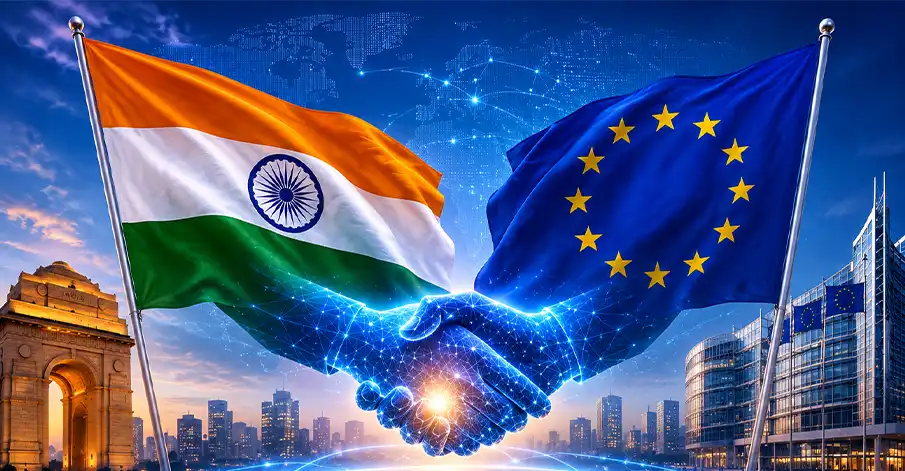
The India-EU Trade and Technology Council (TTC) met for the third time, in Brussels, on 15 July 2026. The meeting was co-chaired, on the EU side, by European Commission Executive Vice-President for Tech Sovereignty, Security and Democracy Henna Virkkunen, Commissioner for Trade and Economic Security, Interinstitutional Relations and Transparency Maroš Šefčovič and Commissioner for Startups, Research and Innovation Ekaterina Zaharieva. On the Indian side, it was co-chaired by External Affairs Minister Dr. S. Jaishankar, Commerce and Industry Minister Piyush Goyal, and Minister of State for Electronics and Information Technology Jitin Prasada.
European Commission President Ursula von der Leyen and Prime Minister of India Narendra Modi established the India-EU TTC in April 2022 as a key platform to address challenges in the areas of trade, trusted technology and security, while deepening their cooperation.
India and the European Union, as two large and vibrant democracies with open market economies, shared values and pluralistic societies are natural strategic partners in an increasingly complex geopolitical environment. In this regard, the two sides recalled the historic 16th India-EU Summit held in New Delhi on 27 January 2026 wherein the leaders had underlined their commitment to raise their strategic partnership to a higher level.
At a time when trade and technologies are becoming increasingly intertwined, India and the EU continue to develop a constructive dialogue based on shared values and objectives. Both sides recognise the TTC as an increasingly important bilateral forum for enhanced cooperation on challenges related to trade, technologies and security, while fostering the common objective of promoting global stability and economic security and underpinning sustainable, innovative and inclusive economic growth.
The India and the EU share the objective to upgrade the current format of the TTC, as agreed in the ‘Towards 2030: A Joint India-European Union Comprehensive Strategic Agenda’ adopted on 27 January 2026. It is envisaged that the transformed model would facilitate work on specific value chains broadly within the existing working groups combined with stronger business engagement to deliver concrete outcomes. Both sides tasked their officials with developing the detailed governance arrangement for agreement later this year.
Working Group 1 on Strategic Technologies, Digital Governance, and Digital Connectivity
India and the European Union reaffirm their shared commitment to deepening digital cooperation under Working Group 1 on Strategic Technologies, Digital Governance, and Digital Connectivity. They agree on the need to continue technical work to improve interoperability of digital trust services, develop a practical cooperation framework on semiconductors, share best practices on artificial intelligence (AI) adoption, explore enhancing cooperation in high-performance computing (HPC) and quantum technologies, support the mobility of skilled ICT workers, and intensify coordination on next generation telecom and 6G standardisation.
Building on the signing of the Administrative Arrangement on Advanced Electronic Signatures and Seals in January 2026, India and the EU intend to continue technical exchanges to improve interoperability and mutual recognition of e-signatures. They will advance dialogue on digital wallet interoperability, including business wallets, and explore a pilot linking the EU Digital Identity Wallet and the Indian DigiLocker for citizens and entities, based on jointly agreed use cases.
India and the EU collaborated to ensure a successful AI Summit in New Delhi in February 2026 and organised panel discussions with leading AI pioneers, policymakers and CEOs on responsible innovation, including the Code of Practice for general-purpose AI models, as well as public-sector AI innovation and transformation. Both sides will continue exploring best practices for AI adoption, including by advancing governance approaches for emerging AI applications, with healthcare as a potential focus area. They also agreed to explore the development of a Joint Artificial Intelligence Roadmap.
Both sides will also continue to advance cooperation on HPC, including through a coordinated India-EU project supporting joint R&D and knowledge exchange in the areas of natural hazards, climate change, and bioinformatics. India and the EU will explore expanding joint activities in HPC and explore collaboration in the field of quantum technologies.
Both sides reaffirmed their shared commitment to advancing cooperation in the semiconductor sector, with a focus on strengthening resilient, secure, and trusted semiconductor supply chains. To that end, both sides agreed for a joint India-EU roundtable during the Semicon India 2026. Both sides also agreed to strengthen mutually beneficial collaboration in research and development (R&D) and capacity building in Semiconductor sector. The two sides also emphasised facilitating investments in semiconductor and electronics ecosystems and resilient supply chains, and enhancing cooperation on advanced manufacturing and materials and critical minerals supply chains by incorporating additional relevant stakeholders. Both sides will also explore collaboration between Semiconductor Design Facilities under the India Semiconductor Mission and EU Pilot Lines under the EU Chips Act for access to advanced Process Design Kits (PDKs) and technology platforms and shuttle programs to enable cost-effective silicon prototyping.
The sides recall the importance of continuing collaboration on digital skills and talent in the context of the European Legal Gateway Office pilot in India launched in February 2026. The pilot aims to act as a one stop hub to provide information and support the movement of workers, starting with the ICT sector. Both sides will explore collaboration on digital skills, including through possible interaction between the EU Digital Skills Academies and NIELIT Digital University Platform to enhance digital talent in cutting-edge technology sectors.
Both sides reiterate the importance of intensifying collaboration and seeking alignment on global interoperable standards, including 6G and strengthening collaboration in digital infrastructure.
Both sides will explore cooperation on other topics of mutual interest, such as data governance.
Working Group 2 on Clean and Green Technologies
India and the EU welcome the rapid progress in taking forward the initiatives in the area of research and innovation agreed at the Summit. The two sides are poised to commence formal negotiations on India’s association to Horizon Europe, the EU’s flagship EUR 93.5 billion research and innovation funding programme, with a view to advancing the negotiations constructively in accordance with their respective internal procedures and requirements and with the aim to conclude these before the end of 2026. This is a historic and strategic shift towards a long-term institutional framework of cooperation between both sides, which will allow Indian researchers and innovators to fully participate in the programme as from 2027.
Building upon the existing R&D projects and cooperation, both sides look forward to further collaboration in areas such as health, water and agrifood.
The two sides are also ready to set up the first ever India-EU Innovation Hub, that will focus on ‘Electric Vehicle Charging Technologies and Testing’, driven by the European Commission’s Joint Research Centre and the Automotive Research Association of India. This will become an operational platform bringing together research capacity, testing infrastructure and standards expertise, connecting with startup ecosystems from both sides. It may unlock bilateral market opportunities, in line with the India-EU Free Trade Agreement.
In addition, since the 2025 India-EU TTC Ministerial, substantial progress has been made on the priority workstreams under Working Group 2 on Clean and Green Technologies. Last year, the two sides agreed on a joint investment of EUR 60 million over four years to support collaborative research through three exceptional coordinated calls in Horizon Europe bringing researchers from India and the EU to work together towards shared solutions. Four projects have been selected, and a fifth one will start in 2027. On waste-to-hydrogen, BHARAT-EU and BioHAVEN will develop pyrolysis of biomethane generated from agricultural and industrial biogenic waste combining different technologies to produce renewable hydrogen. On marine pollution, SEATRACE and HARMONY, scheduled to commence in September 2026 will deploy AI-driven models and advanced biosensors across 39 pilot sites in the Atlantic, Arctic, Mediterranean, and the Indian Ocean to assess and mitigate complex pollutant impacts on marine ecosystems. On recycling of EV batteries, the focus will be on critical raw material recovery and battery circularity solutions. Both sides will explore the scale-up of the solutions emanating from the three research and innovation coordinated calls set out above.
Substantive knowledge exchanges have also taken place between EU and Indian experts since last year. A second workshop on Electric Vehicles Charging Technologies at the European Commission’s Joint Research Centre E-mobility Lab in Ispra, Italy, deepened the bilateral dialogue and the industry’s engagement in charging infrastructure standardisation processes and will be the basis of the first India-EU Innovation Hub. The India-EU Ideathon on combating Marine Plastic pollution demonstrated strong added value in terms of innovation capacity building, international collaboration, and early-stage solution development, where 19 cross-border teams comprising 93 participants from India and the EU participated. The three winning teams were awarded EUR 5,000 each and offered extensive mentoring from experts to take forward their ideas.
In the second part of 2026, India and the EU will share knowledge on Hydrogen Valleys building on the existing cooperation and will further work on hydrogen-related safety standards to compare approaches, discuss operational experience, and identify concrete future avenues for collaboration.
Working Group 3 on Trade, Investment and Resilient Value Chains
The European Union and India reaffirm their commitment to deepening economic cooperation within Working Group 3 on Trade, Investment, and Resilient Value Chains. In an increasingly complex geopolitical and economic environment, both sides stress the importance of collaborative action to foster shared prosperity, mitigate global disruptions, and build sustainable, future-ready value chains.
India and the EU will continue to work to enhance the resilience of value chains by prioritising transparency, predictability, diversification, security and sustainability. In the agri-food, active pharmaceutical ingredients, and clean technologies sectors, both sides continue to engage on addressing vulnerabilities, promoting innovation and strengthening supply chains.
Recognising the urgency of food security amid growing global challenges and impacts of climate change, India and the EU will exchange experiences on contingency planning in the agri-food sector, leveraging lessons learnt from the COVID-19 crisis.
To safeguard the stability of supply chains of active pharmaceutical ingredients, both sides will continue discussions on supply chain resilience.
Cooperation in clean technology supply chains spans solar, offshore wind, and renewable and low carbon hydrogen and focuses on mapping out sectoral capabilities, investment incentives, and R&D priorities, as well as assessing vulnerabilities and reducing trade barriers. By exploring synergies across these value chains, India and the EU aim to accelerate the transition to a low carbon economy in line with their respective climate and energy objectives, while ensuring economic competitiveness.
To underpin these efforts, both sides will facilitate business-to-business engagement, supported by regular policy dialogues, research collaboration, and risk-mitigation strategies.
India and the EU welcome the progress achieved so far through the Trade and Technology Council framework in addressing priority market access issues. Both sides acknowledged their respective interests in the area of agricultural trade and the need to ensure an efficient and timely handling of pending and future SPS-related market access applications. Both sides reaffirmed the importance to achieve concrete outcomes for the industry in the area of technical regulations, including Quality Control Orders and relevant EU regulations, and encouraged cooperation activities to support trade facilitation for both industries.
On organic products, both sides noted the progress made in ongoing technical discussions within the dedicated track and reaffirmed their resolve to achieve reciprocity, notably through the negotiation of mutual equivalence recognition to facilitate trade.
Following the 14th WTO Ministerial Conference, India and the EU reiterate their unwavering support for the multilateral trading system, which remains indispensable for stability and inclusive growth. Both sides acknowledge the urgent need for substantial WTO reform to ensure the organisation can effectively address contemporary trade challenges, including on level playing field and industrial policies, and deliver meaningful outcomes for its members.
On carbon border adjustment, both sides recognised the importance of ensuring that Indian entities have adequate and timely access to a sufficient number of accredited verifiers.
Both sides further committed to initiatives aimed at diversifying and strengthening supply chains in line with the landmark India-EU Free Trade Agreement objectives, including through trade and investment facilitation measures.
Looking ahead
Recognising the growing role of deep-tech startups, innovation ecosystems, and businesses in bilateral cooperation, both sides agreed to explore the establishment of a dedicated platform under the TTC to advance discussions on the Blue Valleys initiative. Under this framework, they will work towards developing sector-specific industrial clusters in strategic value chains, bringing together regulators, industry, startups and other stakeholders to promote regulatory cooperation, standards alignment, innovation, skills development and investment facilitation.
Furthermore, India and the EU are ready to establish a Deep-Tech Startup Partnership involving relevant stakeholders including the European Innovation Council and Start-Up India aimed to support cross-border market access and commercialisation pathways for Indian and EU deep-tech startups.
The two sides also agreed to hold, on an annual basis, the India-EU Business Forum launched during the 16th India-EU Summit as well as regular sector specific industry interactions focusing on priority sectors.
Both sides agreed to explore the need to place greater emphasis on industrial partnerships and skills development within the TTC framework.
Through these collective actions, India and the EU are forging a more integrated, resilient, and sustainable economic partnership – one that delivers tangible benefits for businesses, consumers, and the global community. Both sides agreed to hold the next Ministerial Meeting of the TTC in New Delhi in 2027.
Disclaimer: The above press release has been provided by Ministry of External Affairs . CXO Digital Pulse holds no responsibility for its content in any manner. Reproduction or Copying in part or whole is not permitted unless approved by author.


 met for the third time, in Brussels, on 15 July 2026. The meeting was co-chaired, on the EU side, by European Commission Executive Vice-President for Tech Sovereignty)