


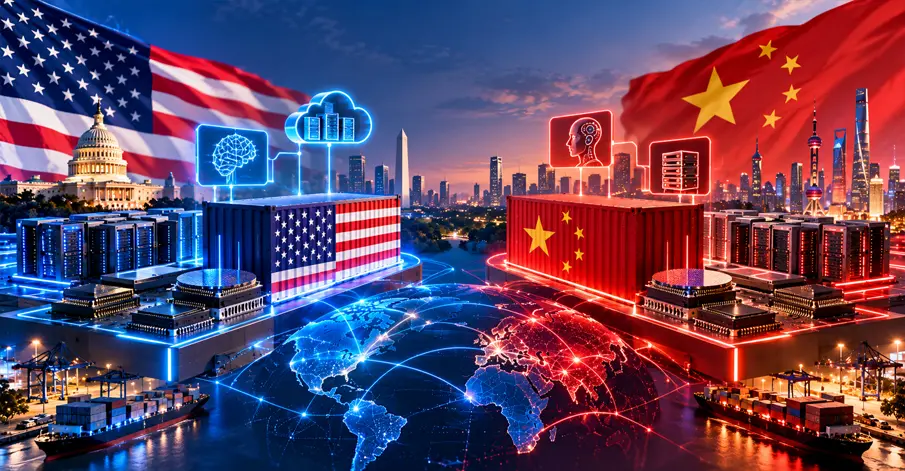
The United States and China are increasingly organising international technology partnerships around competing AI frameworks, creating new choices for countries seeking access to advanced chips, affordable models, data-centre investment and a role in setting technical standards.
The US-led Pax Silica initiative is focused on trusted semiconductor and AI supply chains, technology partnerships and advanced manufacturing. China’s World AI Cooperation Organisation promotes a different structure centred on broader participation, open-source systems and Chinese financing for developing economies.
The distinction is not limited to model providers. Participation can influence access to high-end processors, data-centre agreements, manufacturing projects and the institutions in which future AI rules are shaped. US officials have indicated that countries participating substantially in rival initiatives may not qualify as trusted Pax Silica partners.
China has used open models and development financing to build a wider coalition. Official Chinese grants and loans have supported AI-related projects or enabling infrastructure in at least 77 low- and middle-income countries. Initial members of its cooperation organisation include Pakistan and Russia, while several other countries are considering participation.
Kazakhstan has attempted to participate in both systems. Its AI minister joined the US supply-chain grouping and subsequently attended the creation of China’s organisation. The country has also signed an investment agreement potentially worth $10 billion involving Nvidia for a data-centre cluster while continuing to attract Chinese capital.
Indonesia, which has significant nickel and copper resources used by technology industries, has joined the Chinese initiative while seeking continued access to US investment and technology. Singapore is hosting Anthropic’s latest Asian office and is also evaluating participation in China’s organisation. Saudi Arabia has combined Nvidia infrastructure arrangements with a platform based on a Chinese open model.
Japan remains closely aligned with the United States on semiconductors, security and trusted AI standards, while retaining the option of using lower-cost Chinese models for applications it classifies as lower risk. France is pursuing a more independent route through domestic model development led by Mistral.
India is expanding subsidised national compute, supporting indigenous foundation models and attracting US technology investment while maintaining a policy focus on sovereign capability. The IndiaAI Mission had expanded shared compute capacity beyond 45,000 GPUs by June 2026 and selected 20 indigenous foundation-model proposals. Those programmes provide domestic capacity but remain connected to international semiconductor, cloud and model ecosystems.
The emerging bloc structure makes procurement and standards decisions increasingly interconnected. Governments and enterprises must consider not only performance and cost but also export controls, data jurisdiction, interoperability and long-term access to hardware. The result is a global AI market in which technology architecture and geopolitical alignment are becoming more difficult to separate.



