


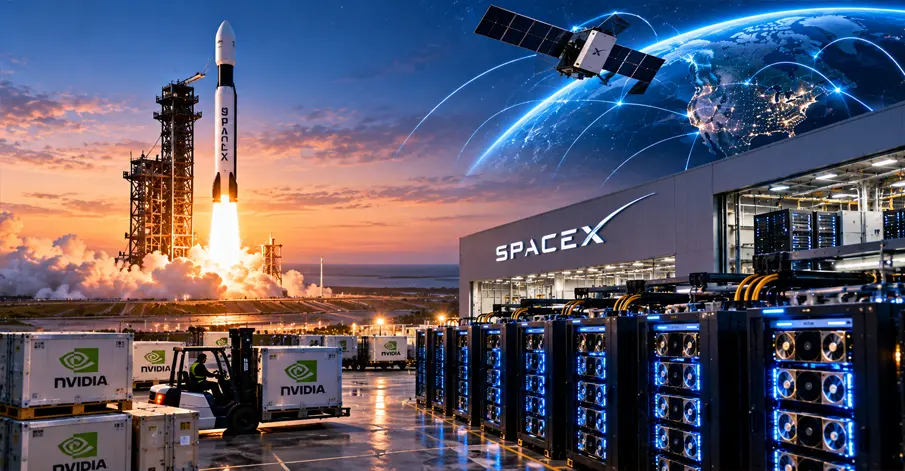
SpaceX has closed $40 billion in debt financing intended primarily to fund graphics-processing-unit purchases scheduled to arrive during the first and second quarters. Elon Musk said the financing consists largely of callable debt and that the company’s investment-grade status, Starlink revenue and launch business had supported continued access to credit.
The completed financing follows earlier discussions with banks and asset managers about funding Nvidia AI-chip purchases. Its scale illustrates the amount of external capital required by companies attempting to secure large volumes of advanced processors while simultaneously constructing the power, networking and data-centre capacity needed to operate them.
SpaceX’s revenue increased 161% year on year to $14.58 billion during the three months ended 30 September. Capital expenditure nearly tripled to $19.6 billion as the company invested heavily in computing infrastructure and other expansion programmes.
The company’s AI-related plans extend beyond purchasing processors. Terafab, the semiconductor-manufacturing joint venture involving SpaceX and Tesla in Austin, is expected to produce its first test chip around May or June 2027. Volume production is targeted for the third quarter of 2028.
SpaceX had identified manufacturing its own GPUs as a substantial capital requirement in its stock-market filing. The combination of debt-funded near-term purchases and a longer-term chip-production programme suggests a strategy designed to secure immediate access to commercial accelerators while developing greater control over future supply.
The borrowing also demonstrates how operating businesses outside conventional cloud computing can be used to finance AI expansion. Starlink subscription revenue and launch operations provide cash flow and credit support for investments that would be harder to fund through a standalone early-stage AI company.
Large procurement programmes can affect the wider compute market by reserving production capacity for buyers able to enter multibillion-dollar agreements. Indian AI developers are already reporting three-to-six-month waits for GPUs, while domestic infrastructure providers are expanding capacity to respond to shortages. The entry of additional large-scale buyers increases competition across chips, high-bandwidth memory, networking equipment and data-centre components.
SpaceX’s financing sits alongside the global trend of technology companies using debt, supplier arrangements and long-term capacity commitments to fund AI infrastructure. These structures transfer part of the cost across multiple years but do not remove the operational risks associated with utilisation, equipment obsolescence and rapidly changing chip architectures.
The company has not provided a detailed breakdown of lenders, borrowing costs or the number and model of GPUs covered by the financing. Musk said the purchases were not expected to be a major factor in the current quarter because deliveries are concentrated in the first half of the following year.