


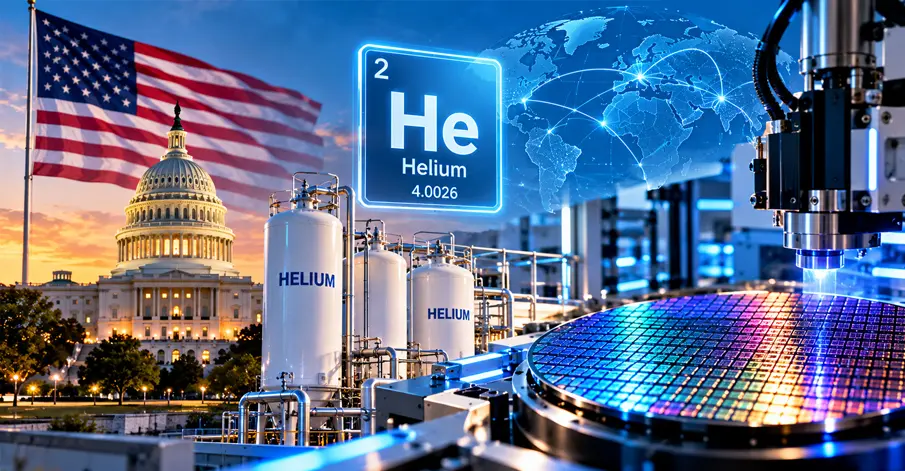
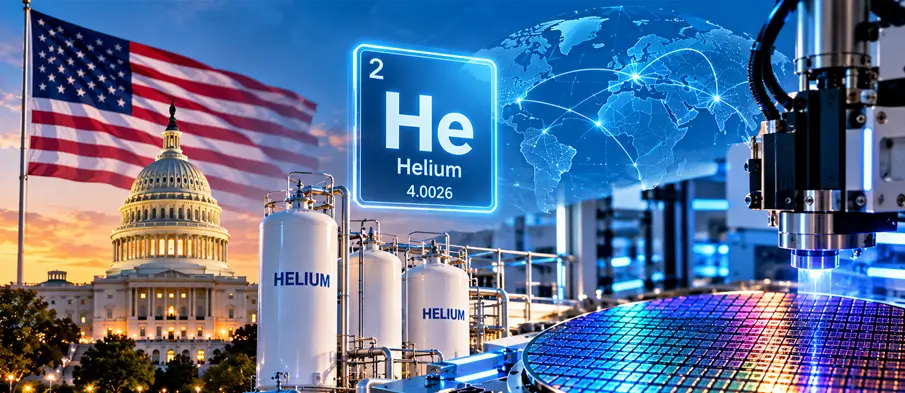
The United States has designated helium as a critical material because of its role in semiconductor manufacturing, quantum and supercomputing, energy systems, medical imaging and scientific research. The classification makes additional federal financing available to helium producers and subjects the supply chain to closer government monitoring.
Helium is used in chip fabrication for cooling, photolithography and leak detection. Its exceptionally low boiling point, chemical stability and non-combustible properties make it difficult to replace in advanced industrial processes. Semiconductor facilities require a dependable supply because shortages can affect production environments and specialised manufacturing equipment.
The United States produced 81 million cubic metres of helium in 2025, representing approximately 43% of global output. About 38 million cubic metres of that production was exported. Qatar and Russia are the other leading producers, leaving the international supply chain concentrated across a small number of jurisdictions.
Supply risks have increased following severe restrictions on Qatari exports caused by the closure of the Strait of Hormuz and damage to infrastructure in the region. Russia introduced temporary helium-export controls in April to protect domestic availability. These developments have placed greater attention on the resilience of semiconductor and research supply chains.
Helium becomes the twentieth material covered by the US Energy Department’s critical-materials framework. A substance qualifies when it performs an essential function in one or more energy technologies and faces a high probability of supply disruption. Fluorine is the only other gas on the list.
US output has remained near 80 million cubic metres annually since 2021, but existing extraction facilities are operating close to their limits. Helium is generally recovered as a by-product of natural-gas processing, and new extraction plants can require years of permitting and construction.
The United States previously maintained a federal helium reserve in Texas. Congress ordered its privatisation in 2013, and the federal system was sold to industrial-gas company Messer in 2024. The latest classification reintroduces a more active federal role through financing and supply-chain oversight rather than restoring the former reserve structure.
Helium availability is relevant to India’s planned semiconductor fabrication, assembly and advanced-packaging capacity because many upstream materials and specialised gases remain internationally sourced. India’s emerging-sector investment pipeline places more than ₹5.27 lakh crore of indicative public and private investment around semiconductors, while domestic projects must compete within global equipment and materials markets.
The classification therefore arrives as governments are broadening semiconductor policy beyond fabrication equipment and chip design. Industrial gases, cooling systems, minerals, chemicals and packaging inputs are becoming part of national technology-security planning as countries expand domestic manufacturing programmes.