


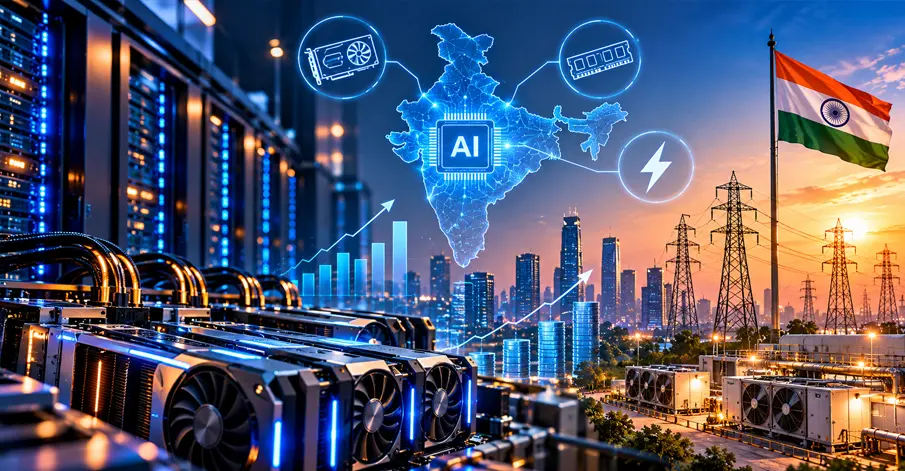

Artificial intelligence, semiconductors and defence are expected to lead capital formation across India’s emerging industries, with indicative public and private investment pipelines of approximately ₹5.9 lakh crore, ₹5.27 lakh crore and ₹5.07 lakh crore, respectively. The projections form part of a Union Bank of India research assessment examining how twelve developing sectors could generate demand for capital and specialised credit products.
The report expects financing opportunities over the next three to five years to become more concentrated in commercially structured assets and supply-chain businesses. Identified areas include semiconductor assembly and advanced packaging, battery storage and recycling, lithium iron phosphate and sodium-ion manufacturing, green-hydrogen projects with assured offtake, and component suppliers serving the defence sector.
Data-centre financing is expected to broaden towards edge facilities and colocation infrastructure as more AI workloads move from model training to inference. Inference is the process through which a trained AI system generates responses or performs tasks, and its expansion can create geographically distributed demand for computing and network capacity closer to users and enterprise data.
The report identified debt-financing routes in ten of the twelve sectors it examined. AI and space remain predominantly equity-funded because of rapid technology cycles, uncertain revenue profiles and long development periods. GPU clusters used for AI infrastructure may require substantial upgrades every 18 to 24 months, creating an asset-obsolescence risk that conventional lenders are not structured to absorb easily.
Semiconductor projects can require five to eight years to generate returns, while space-sector projects may take seven to ten years. Those periods can exceed conventional loan tenures and complicate the matching of debt repayments with commercial cash flows. Delayed customer payments and uncertain demand add further underwriting risks in defence, hydrogen and other capital-intensive segments.
The research recommends that banks develop dedicated sector expertise rather than evaluate these projects through general corporate-lending frameworks. Potential instruments include milestone-linked disbursements, equipment leasing, receivables financing and green loans. Development-finance institutions and project-finance structures could have a larger role in renewable energy, critical minerals, hydrogen and semiconductor projects.
India’s renewable-energy capacity was placed at 288.6 gigawatts against the national target of 500 gigawatts by 2030. The electric-vehicle and battery-storage market was projected to expand from $34 billion to $113 billion by the end of the decade.
The investment figures capture the scale of the pipeline, while the report’s financing analysis identifies the practical constraints surrounding its execution. Banks will need to account for technology replacement cycles, long construction periods, evolving demand and different sources of repayment across each sector. This is particularly relevant as domestic industrial and technology policy moves from announcing capacity targets to financing factories, infrastructure and operating supply chains.