 We wake up everyday to some new headlines of soaring AI spend. We are witnessing AI evolve rapidly from simple Q&A tools to reasoning engines capable of making decisions and executing complex workflows. Organizations are investing aggressively in these capabilities. Yet as enterprise adoption accelerates, the next critical challenge for business leaders is not simply managing expenditure – it is establishing the financial transparency, operational accountability, and operating discipline required to translate these investments into sustainable competitive advantage. AI success must be measured at three levels: Does it improve the work? Does it improve the economics of the work? And does it create measurable enterprise value?
1. The AI Spending Paradox
Despite aggressive investments, a stark paradox has emerged: while individual productivity is improving, enterprise-level returns remain elusive. According to McKinsey’s State of AI 2026, 80% of respondents report individual productivity improvements from AI. However, only 37% attribute any positive enterprise-level EBIT impact to those initiatives. We are becoming highly sophisticated at consuming intelligence, but are we equally sophisticated at measuring its value? This question is central to the next phase of enterprise AI adoption.
2. The CXO dilemma: Questions that matter
For executive leadership, AI is no longer a localized innovation experiment. It is a rapidly growing line item in enterprise operating expenditure and strategic capital allocation. To successfully navigate this journey, CXOs must address five fundamental questions:
- Visibility: How much are we actually spending on AI across the enterprise?
- Accountability: Which business functions, applications, and processes are driving that consumption? (Typical Allocation Problem)
- Value: Are these investments translating into measurable revenue, productivity, cost savings, or risk mitigation?
- Predictability: How do we accurately forecast and control consumption without choking innovation?
- Prioritization: Which AI initiatives should we fund, accelerate, or simply discontinue?
Some forward-thinking enterprises are already demonstrating the discipline. Singapore’s DBS Bank reported SGD 1 Billion in economic value in 2025, generated from more than 430 data analytics and AI/ML use cases, supported by over 2,000 models. Crucially, as detailed in their 2025 Annual Report, this figure includes all analytics initiatives, not just GenAI. It shows how an enterprise can successfully embed AI into its core operating model. The immediate challenge for organizations is to establish a similar, rigorous discipline in measuring the economics of their AI investments, rather than celebrating metrics like number of models or agents deployed.
3. Why AI spend is more complex than traditional IT
Traditional IT spending relies on established financial models covering software licenses, hardware, cloud consumption, and personnel. But AI introduces three additional layers of complexity:
- Visible AI cost is only part of the picture: Tokens – the units of information processed by AI models – are often the focus of cost discussions. But enterprise AI also relies on data retrieval (data egress, database costs), compute infrastructure, application integration, monitoring, etc. A single AI agent may invoke multiple tools and models before completing a task (demonstrating the evolution from simple tasks to agentic workflows).
- AI consumption is fragmented: Enterprises deploy AI across SaaS applications, direct APIs, cloud platforms, and autonomous agents. Platforms like Gemini Enterprise and Claude Enterprise are pioneering this expansion – offering organizations flexible choices between seat subscriptions and usage-based consumption models.
- Consumption is variable and difficult to attribute: An identical business request may consume different resources depending on data complexity, reasoning requirements, or number of retries.
An enterprise may know its total AI expenditure and yet struggle to identify which business outcomes actually generated that cost. And this is the central challenge: How do we move from tracking the cost of technology to understanding the economics of the work being performed.
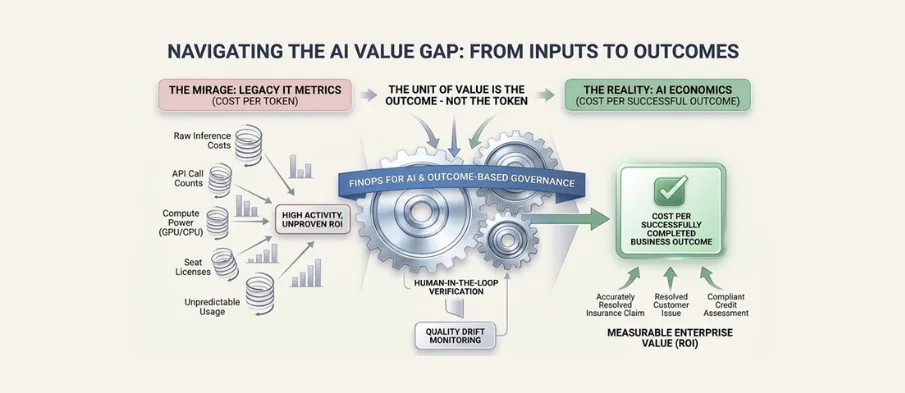
4. The Shift: from ‘Cost per Token’ to ‘Cost per Outcome’
A lower-cost AI model that repeatedly fails or requires extensive correction may ultimately be more expensive than a higher-performing alternative. Hence, the real economic equation is not simply the price of inference or tokens. It is the total operating cost divided by the number of successfully completed business outcomes, followed by the financial value those outcomes create. This changes the discussion from How much AI are we using? to “How economically are we delivering business value?”
Consider an insurance company processing 100,000 customer service requests monthly. Suppose the organization introduces AI agents to support customer service representatives (CSRs), reducing the average handling time by 90 sec per request, even after necessary human verification. This represents ~ 2,500 hours of monthly employee capacity. At an illustrative fully loaded employee cost of $50 per hour, this could be ~$125,000 monthly. Now imagine the entire AI solution costs $45,000 per month (model consumption, platform services, infrastructure, integration, and ongoing operations). The difference represents approximately $80,000 in potential monthly economic benefit.
Does this automatically translate into $80,000 in financial savings? Not necessarily. If the saved employee capacity is simply absorbed into existing activities, the company may see limited direct P&L impact. However, if that capacity enables the organization to process additional claims, avoid incremental hiring, improve customer retention, or reduce operating costs, the financial benefits become far more tangible. This example highlights an important evolution in enterprise technology economics.
For decades, we have measured IT efficiency through cost per user, infrastructure utilization, and application performance. AI introduces an opportunity to measure something more meaningful: cost per successful business outcome. For an insurer, the cost per accurately resolved claim. For a retailer, the cost per customer issue successfully resolved. For a bank, this could mean the cost per compliant credit assessment.
To measure AI economics meaningfully, enterprises need to look at three levels of performance.
- First, operational improvement: is AI improving speed, accuracy, or throughput compared with the existing process?
- Second, unit economics: what is the total cost per successfully completed business outcome, including AI processing, infrastructure, and human intervention?
- Third, investment returns: are these improvements actually generating measurable revenue, cost savings, or risk reduction?
Consider two AI agents handling insurance customer requests. One processes each request at a fraction of the cost but requires frequent human intervention. The second is more expensive per interaction but completes significantly more requests successfully without additional support.
When we incorporate human intervention, rework, and operating expenses, the more expensive model may actually deliver a lower cost per successfully resolved request.
This is the fundamental shift in AI economics. The conversation must move from cost per token or cost per inference to cost per successful business outcome. These distinctions matter. A 30% improvement in processing time is a valuable operational metric, but it does not automatically represent a 30% financial return. The real challenge is to connect improvements in operational performance to lower unit costs and, ultimately, measurable business value.
5. Four Actions for CXOs
To move from experimentation to sustainable enterprise value, organizations need to establish these management disciplines:
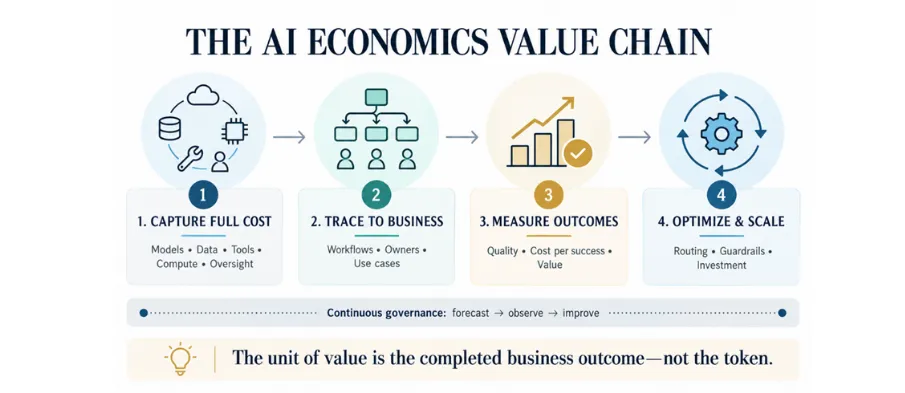
1. Establish end-to-end AI cost visibility
Organizations must begin with a comprehensive view of AI spend across the full tech landscape. This means looking beyond tokens and AI subscriptions to include compute, data infrastructure, retrieval, integration, orchestration, monitoring, and operational support. The emerging discipline of FinOps for AI is particularly relevant. According to the FinOps Foundation’s 2026 survey, 98% of surveyed FinOps practitioners now manage AI spending, compared with just 31% two years earlier. The immediate priority should be creating a consolidated view of AI costs across cloud platforms, enterprise applications, and external model providers.
Imperative: Establish a reliable enterprise-wide AI cost baseline and identify the major drivers of consumption.
2. Link AI consumption to business accountability
Financial transparency is only useful when spending can be connected to its business purpose. Enterprises should progressively allocate AI costs to business units, applications, workflows, and use cases rather than simply to technology platforms. This requires combining cloud billing information with application-level usage data, model activity, and business process information. Enterprises need to embed cost governance into the design and operation of AI solutions rather than address spending only after invoices arrive. This includes budgeting, consumption alerts, forecasting, model selection, and controls over autonomous agent activity.
Not every business request needs the most sophisticated reasoning model. Increasingly, AI architectures can select more economical models for routine work while reserving advanced capabilities for complex, high-value tasks. Recent developments in platforms such as Gemini Enterprise, Claude, etc. including multi-model orchestration, intelligent routing, and spending controls, illustrate how economic optimization is becoming part of enterprise AI architecture. Governance should also evolve with the investment lifecycle. Early experiments need controlled budgets and clear success criteria. Proven initiatives should receive funding to scale, while those consistently failing to demonstrate value should be redesigned or discontinued. This requires closer collaboration between Finance, Technology, and Business Operations, with investment decisions based on measurable results.
Imperative: Assign business ownership to material AI investments, with clear accountability for both consumption and expected outcomes.
3. Measure realized business value, not just AI activity
High AI adoption does not automatically equate to business value. Having 10,000 employees using an AI tool is an activity indicator, not an economic return. Organizations must establish a small number of business KPIs linked to three proven value levers:
- Revenue growth: Increased conversion, customer retention, or new business opportunities.
- Cost efficiency: Reduced processing costs, improved capacity, or avoidable expenditure.
- Risk reduction: Fewer errors, reduced fraud losses, stronger compliance, or improved business resilience.
These measures should distinguish between theoretical productivity gains and actual financial returns. For larger initiatives, Finance and Business Operations should validate the baseline, monitor realized benefits, and periodically challenge the original investment assumptions.
This requires implementing financial and technical guardrails that empower teams to experiment and innovate rapidly without budget overruns. They need to develop a repeatable framework for identifying, funding, and scaling the highest-value AI use cases across the enterprise.
Imperative: Measure AI through business outcomes, including quality-adjusted unit economics, rather than technology utilization alone.
4. Build financial guardrails to scale AI responsibly
Because AI systems can drift over time as models, prompts, and data change, value realization requires an ongoing assurance loop rather than a single post-pilot check. Finance and operations must continuously monitor baseline decay, model performance drift, and true quality-adjusted costs.
Imperative: Implement financial and technical guardrails that empower teams to experiment rapidly while maintaining disciplined cost controls
The Economics of Intelligence: A New Leadership Mindset
For CXOs, the next challenge is not simply adopting the most advanced AI models or deploying the largest number of intelligent agents. It is developing the financial transparency, business accountability, and operating discipline required to translate these capabilities into sustainable competitive advantage. Ultimately, AI economics is not about minimizing the cost of intelligence. It is about maximizing the business value that intelligence creates.
About the author:
Ashu Bhatia is the APAC Partner Engineering Head for Google. With over two decades of experience in consulting and industry in the USA, Europe, and Asia, he is very passionate about driving high business performance through orchestration of strategy, technology, and human capital. A Certified Six Sigma Black Belt and an MBA from Carnegie Mellon University (USA), he has held management positions with companies like Accenture, Siemens, American Express, etc. He is the author of a book on Technology Strategy called “Value Creation” and host of podcast show, “Tech Bytes with Ash”.