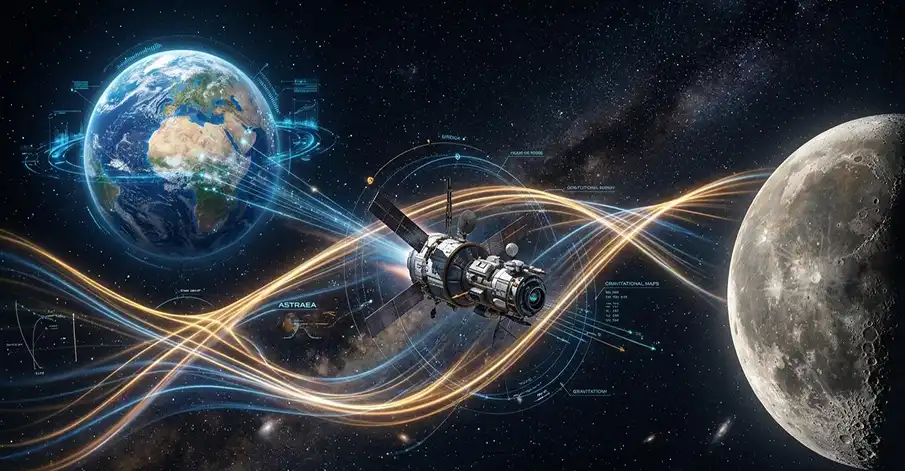
Researchers from University of São Paulo and University of Coimbra have identified a new fuel-efficient route to the Moon that could significantly reduce spacecraft fuel consumption while maintaining continuous communication with Earth. The findings were published in April 2026 in the scientific journal Astrodynamics.
The study focused on improving the efficiency of lunar travel by analysing hidden gravitational pathways in space. Traditionally, lunar missions have relied on trajectories that require large amounts of propellant, increasing launch costs and reducing the available space for scientific equipment and payloads. The newly discovered route offers a more economical alternative by taking advantage of naturally occurring gravitational forces between Earth, the Moon, and surrounding celestial bodies.
To conduct the research, scientists used a computational method known as the “theory of functional connections,” which helped reduce the processing power required for highly complex orbital simulations. Using this technique, the team examined nearly 30 million possible Earth-to-Moon trajectories, with approximately 280,000 of those pathways referenced in the published research paper.
Rather than following the assumption that the shortest path in distance would be the most efficient, the researchers explored unconventional orbital solutions through systematic analysis. Their findings revealed that approaching the Moon from the side opposite to the traditionally used entry point could reduce fuel requirements more effectively.
The newly proposed trajectory takes advantage of gravitational corridors in space known collectively as the Interplanetary Transportation Network. These pathways are created by the combined gravitational influence of planets and moons and allow spacecraft to travel using less propulsion energy. According to the study, the newly identified route saves approximately 58.8 meters per second of fuel compared to the previous best-known lunar transfer path.
In addition to fuel savings, the route offers another operational advantage by maintaining uninterrupted communication with Earth throughout the journey. This is considered a major improvement for future crewed and robotic missions, as spacecraft travelling behind the Moon often temporarily lose contact with mission control.
The researchers noted that the methodology used in the study could play a significant role in future mission planning and deep-space exploration efforts. By identifying less obvious but more efficient trajectories, space agencies and private aerospace companies may be able to reduce mission costs while improving operational reliability for lunar exploration programs in the coming years.