


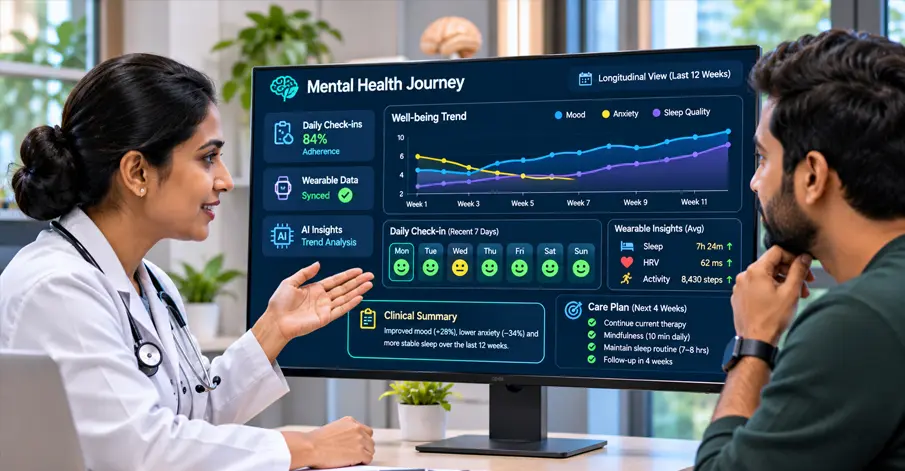
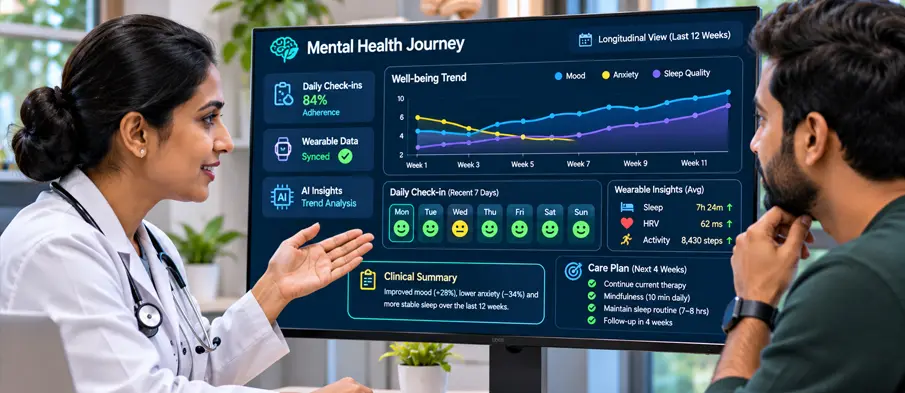
Siggy has launched a mental-health service combining continuous AI-supported monitoring with diagnosis, prescribing and treatment decisions made by licensed clinicians. The New York company has raised $6 million in pre-seed funding led by Village Global.
The service begins with an AI-guided collection of a patient’s history and uses short daily check-ins covering sleep, mood and medication. Data from connected Apple Watch, Oura or Whoop devices can also be incorporated.
These inputs are converted into a daily Siggy Score on a 100-point scale. Patients and clinicians can view the same score, creating a continuous record between formal appointments. The company says the AI retains the patient’s history so clinicians can enter consultations with an updated picture of recent changes.
Siggy has emphasised that licensed professionals retain responsibility for diagnoses, prescriptions and treatment decisions. The AI component is positioned as a system for history gathering, monitoring and continuity rather than an autonomous medical practitioner.
The company was founded by Jonathan and Edvard, entrepreneurs with previous experience building healthcare businesses including Journey Clinical and Nurx. Several investors backing Siggy previously supported companies associated with the founders.
Village Global led the pre-seed round. Other participants include Albert Wenger of Union Square Ventures, Mercury founder Immad Akhund, Coalition Operators, Psymed Ventures, Daft VC, Mystic Ventures and a group of healthcare founders and operators.
Siggy says its service is covered by most major insurance plans across all 50 US states, including Blue Cross Blue Shield, Aetna, UnitedHealthcare and Humana. It estimates that this gives it access to approximately 80% of insured Americans. The service accepts health savings and flexible spending accounts and is being offered free to veterans.
The product enters a sensitive area in which privacy, clinical validation, escalation procedures and the interpretation of wearable data require careful governance. A daily score may assist longitudinal monitoring, but it does not replace a clinical diagnosis and must be understood within the wider treatment context.
The launch provides another model for Indian digital-health and hospital groups evaluating how AI can support clinicians without transferring regulated decisions to automated systems.



