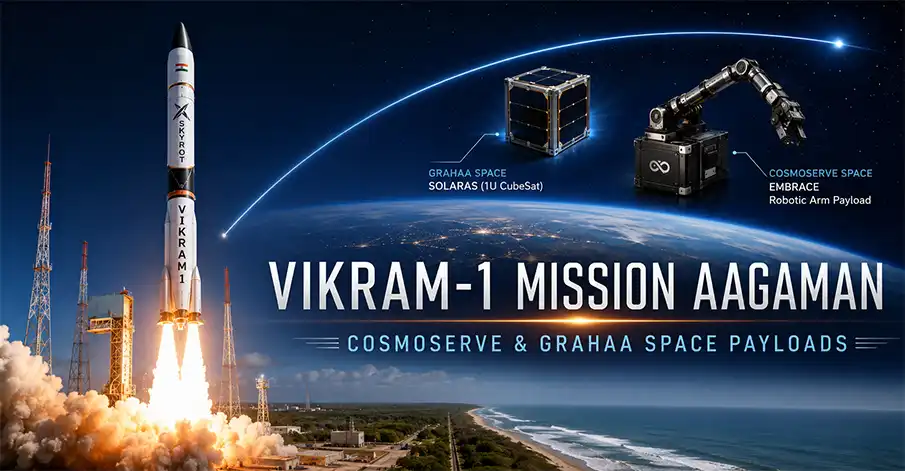
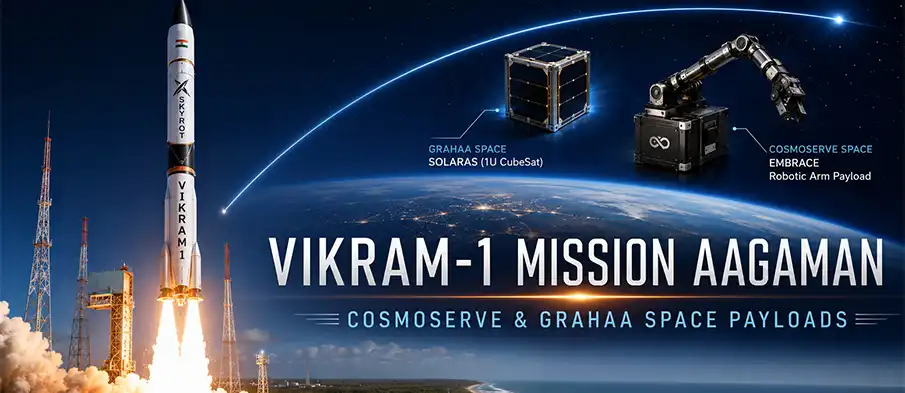
Hyderabad, India: Skyroot Aerospace’s Vikram-1 maiden orbital mission will carry technology demonstration payloads from Cosmoserve Space and Bengaluru-based Grahaa Space, highlighting the growing role of India’s private space sector in testing advanced space technologies in orbit.
The mission, named Mission Aagaman, is planned during the launch window between July 12 and August 4, 2026, from the Satish Dhawan Space Centre in Sriharikota. Vikram-1 is India’s first privately developed orbital-class rocket and is designed to place small satellites into low Earth orbit. The flight will serve as a major technology validation mission for Skyroot Aerospace as it prepares for regular commercial launch operations.
The key objective of the mission is to collect real in-flight performance data from Vikram-1’s systems. The launch is expected to validate critical technologies related to propulsion, guidance, navigation, control, stage separation and overall vehicle performance. These flight insights will help Skyroot strengthen the reliability of its launch vehicle platform for future commercial satellite missions.
Vikram-1 has been developed as a multi-stage launch vehicle using an all-carbon composite structure. The rocket is powered by propulsion systems developed in-house by Skyroot, including solid rocket boosters and 3D-printed engines. The vehicle is designed to carry satellites weighing up to 350 kg into low Earth orbit, making it suitable for small satellite and technology demonstration missions.
One of the important payloads on the mission is Embrace, developed by Cosmoserve Space. The payload will demonstrate an in-orbit robotic arm attached to Vikram-1’s payload deck. The technology is expected to support future applications in satellite servicing, inspection, debris removal and space manufacturing. Such systems are becoming increasingly important as the number of satellites in orbit continues to rise and space sustainability becomes a key concern.
The mission will also carry SOLARAS, a 1U CubeSat developed by Bengaluru-based Grahaa Space. The CubeSat is designed to demonstrate space technologies in orbit and reflects how Indian startups are using private launch platforms to validate compact satellite systems and payload technologies.
In addition to Cosmoserve and Grahaa Space, Vikram-1 will carry other domestic and international payloads, including technology demonstrations from DCubed GmbH and Skyroot’s own SCOPE payload.
The mission marks an important step for India’s commercial space ecosystem. By carrying payloads from startups and technology developers, Vikram-1 is not only testing a private launch vehicle but also creating a platform for in-orbit validation of new space technologies.
If successful, the mission will strengthen India’s position in the global small satellite launch market and give further momentum to private space-tech innovation in the country.