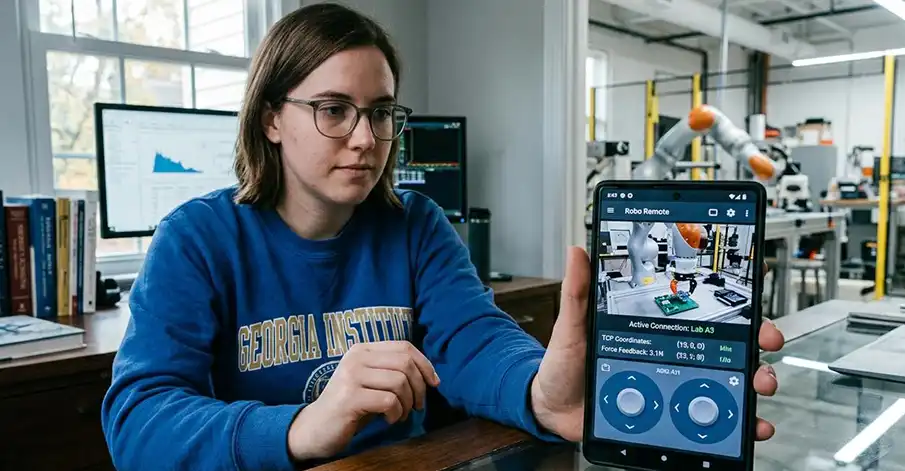
Researchers at Georgia Tech have introduced COBALT, an innovative platform that allows users to remotely operate robotic arms through a smartphone, creating new opportunities for robotics applications, artificial intelligence training, and remote work environments.
The platform is designed to transform everyday smartphones into accessible robotic control devices, enabling users to interact with and manage robotic systems from virtually any location. By leveraging widely available mobile technology, COBALT aims to reduce barriers to robotic operation while expanding access to advanced automation tools for research, industry, and education.
The development represents a significant step toward making robotics more accessible and scalable. Traditionally, operating robotic systems has required specialized equipment, dedicated control stations, or complex hardware configurations. COBALT introduces a more flexible approach by allowing users to control robotic arms through familiar mobile interfaces, enhancing convenience and accessibility.
One of the platform’s most significant contributions is its potential to support artificial intelligence development and training. Remote operation of robotic systems can generate valuable real-world data that may be used to improve machine learning models, robotic decision-making systems, and autonomous task execution capabilities. By enabling broader participation in robotic interactions, the platform could help accelerate advancements in AI-driven automation.
The technology also has implications for the future of remote work. As organizations continue exploring distributed work models, systems that allow individuals to interact with physical equipment from remote locations are becoming increasingly valuable. Applications could extend across industries such as manufacturing, logistics, healthcare, research, and education, where robotic systems are playing an expanding role in daily operations.
COBALT highlights the growing convergence of robotics, mobile technology, and artificial intelligence, creating new possibilities for human-machine collaboration. The ability to remotely control robotic hardware through a smartphone demonstrates how advancements in connectivity and software platforms are reshaping traditional approaches to automation and robotics management.
Beyond operational efficiency, the platform may also contribute to increased accessibility for robotics education and experimentation. Students, researchers, and developers could gain greater opportunities to interact with robotic systems without requiring physical access to specialized facilities.
By combining smartphone accessibility with robotic control capabilities, Georgia Tech’s COBALT platform represents a notable advancement in remote robotics technology and reflects the broader trend toward more connected, intelligent, and accessible automation systems.