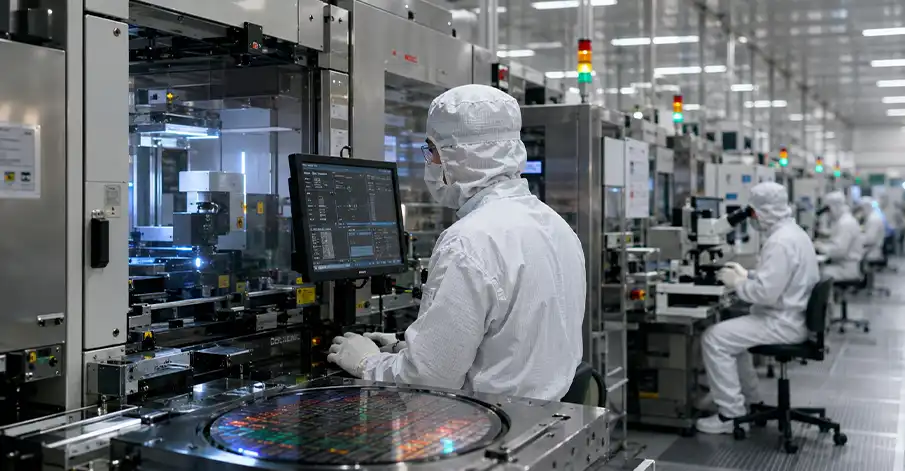
India’s semiconductor industry is at a critical stage of development, with policymakers and industry stakeholders increasingly focusing on expanding domestic manufacturing capabilities to reduce dependence on foreign suppliers. A recent assessment of the country’s semiconductor ecosystem indicates that while significant progress has been made, India is not yet fully equipped to meet its growing domestic demand for semiconductor components and advanced chips.
The report highlights that India’s semiconductor ecosystem currently lacks the scale and capacity required to independently satisfy the country’s rapidly expanding electronics and technology requirements. As demand for smartphones, consumer electronics, electric vehicles, telecommunications equipment, artificial intelligence systems, and data centers continues to rise, the need for a stronger domestic semiconductor base has become increasingly important.
India’s electronics manufacturing sector has experienced substantial growth in recent years, supported by government initiatives aimed at boosting local production and attracting global investment. However, semiconductor manufacturing remains one of the most complex and capital-intensive industries in the world, requiring advanced fabrication facilities, specialized equipment, highly skilled talent, and long-term financial commitments.
The assessment emphasizes the importance of strengthening local manufacturing capabilities to improve supply chain resilience. Developing a robust domestic semiconductor ecosystem is viewed as essential for reducing external dependencies and safeguarding India’s technology sector against future disruptions. Building local capacity could also enhance the country’s competitiveness in strategic industries that rely heavily on advanced semiconductor technologies.
Another key concern identified in the report relates to geopolitical developments and their potential impact on global supply chains. Semiconductor production remains concentrated in a limited number of regions worldwide, making the industry vulnerable to geopolitical tensions, trade restrictions, and supply disruptions. Any major disruption in global semiconductor supply chains could significantly affect India’s electronics manufacturing industry and broader economic growth.
The report suggests that continued investment in fabrication facilities, semiconductor design capabilities, research and development, and workforce training will be necessary to support long-term industry expansion. Strengthening partnerships between government agencies, academic institutions, and private-sector companies is also considered important for accelerating ecosystem development.
India has already launched several initiatives to attract semiconductor investments and encourage domestic manufacturing. These efforts aim to position the country as a significant participant in the global semiconductor value chain while supporting the broader objective of technological self-reliance.
The report concludes that although India has made meaningful progress in developing its semiconductor sector, sustained investment, policy support, and infrastructure development will be essential to achieving long-term self-sufficiency and ensuring supply chain security. As semiconductor technologies become increasingly central to economic growth and national competitiveness, strengthening domestic capabilities is likely to remain a strategic priority for the country in the years ahead.