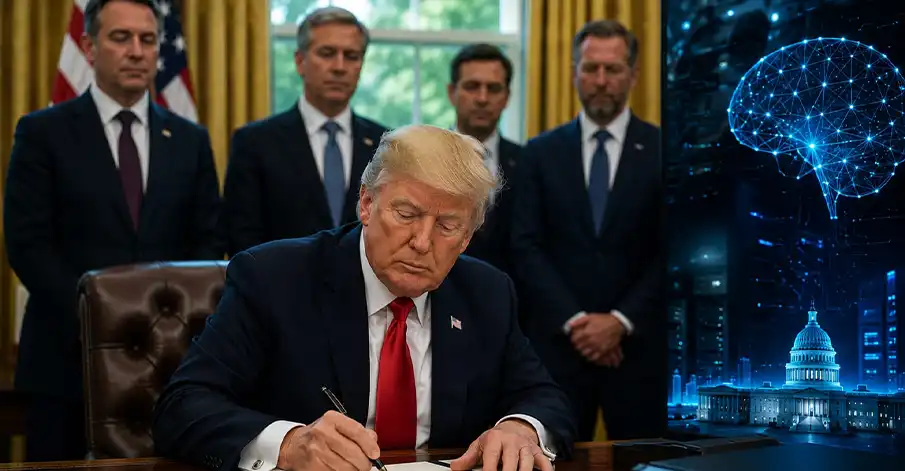
U.S. President Donald Trump has signed a new executive order establishing a framework that enables the federal government to review some of the most advanced artificial intelligence models before they are publicly released. The measure represents a significant shift in the administration’s approach to AI oversight as concerns grow over the cybersecurity and national security implications of increasingly powerful AI systems.
The central provision allows AI developers to provide the government with access to their most advanced models for up to 30 days before a planned public launch. Companies such as OpenAI, Google, and Anthropic may voluntarily participate in the review process, enabling government agencies to evaluate potential cybersecurity risks and assess the broader impact of emerging AI capabilities.
The executive order is intended to strengthen coordination between government agencies and AI developers at a time when frontier AI systems are becoming increasingly capable of identifying software vulnerabilities, automating cyber operations, and influencing critical infrastructure. Officials argue that early access could help authorities prepare defenses against emerging threats before such technologies become widely available.
The 30-day review period represents a compromise between government oversight and industry concerns. Earlier proposals reportedly sought a review window of up to 90 days before release, while technology companies advocated for a much shorter timeframe. The final order reduces the review period to 30 days, reflecting efforts to balance national security priorities with maintaining innovation and competitiveness in the AI sector.
A notable aspect of the order is its voluntary nature. The framework does not create a mandatory licensing, approval, or permitting process for AI development. Instead, it encourages collaboration between government agencies and private-sector AI developers. The administration emphasized that the policy is designed to enhance security without creating regulatory barriers that could slow technological progress.
The move comes amid growing concerns surrounding advanced AI models with powerful cybersecurity capabilities. Some recently developed systems have demonstrated the ability to identify weaknesses in computer networks and critical infrastructure, prompting calls for additional safeguards before public deployment.
The executive order highlights the increasing focus on balancing AI innovation with security oversight as governments worldwide evaluate the risks and opportunities associated with next-generation artificial intelligence technologies.